
Choosing an SMC mould manufacturer in China is not simply a matter of comparing mould prices. For compression molded composite parts, mould design and manufacturing quality have a direct influence on dimensional accuracy, surface finish, cycle time, material flow, demolding, and long-term production stability.
A reliable SMC mould supplier should therefore be able to understand the complete molding process rather than only manufacture the steel tooling according to a 3D model.
For automotive, electrical, industrial, sanitary, and transportation applications, the right tooling solution should be developed around the part geometry, SMC material, press conditions, production volume, surface requirements, and expected mould life.
What Is an SMC Mould?
An SMC mould is a compression mould designed to form Sheet Molding Compound into a finished composite component under controlled pressure and temperature.
Unlike conventional injection moulds, an SMC compression mould must accommodate material charge placement, flow behavior, compression, curing, shrinkage, venting, heating, and demolding.
The mould therefore becomes an important part of the overall molding process.
Typical SMC mould applications include:
- Automotive body components.
- Battery covers and enclosures.
- Electrical boxes and cabinets.
- Water tank components.
- Sanitary and bathroom products.
- Industrial equipment housings.
- Vehicle interior and exterior parts.
- Commercial vehicle components.
Why SMC Mould Design Is Different
SMC compression molding involves a relatively high-viscosity composite charge that flows inside the closed mould before curing.
The mould must therefore be designed to support controlled material flow and avoid common defects such as:
- Short filling.
- Weld lines.
- Air entrapment.
- Surface defects.
- Uneven fiber distribution.
- Dimensional variation.
- Flash.
Mould geometry, charge layout, venting, temperature distribution, and parting line design all influence these results.
What Should an SMC Mould Manufacturer Provide?
A professional supplier should provide more than basic mould machining.
The engineering scope may include:
- Part and mould design review.
- DFM analysis.
- Material and mould steel selection.
- Parting line development.
- Draft analysis.
- Heating system design.
- Venting design.
- Cooling or temperature-control solutions.
- Mould machining.
- Surface treatment and polishing.
- Assembly and fitting.
- Trial molding.
- Dimensional inspection.
- Final mould acceptance.
This engineering approach helps reduce the risk of discovering moulding problems only after the tooling has been installed at the customer's production facility.
Part Design Review Before Mould Manufacturing
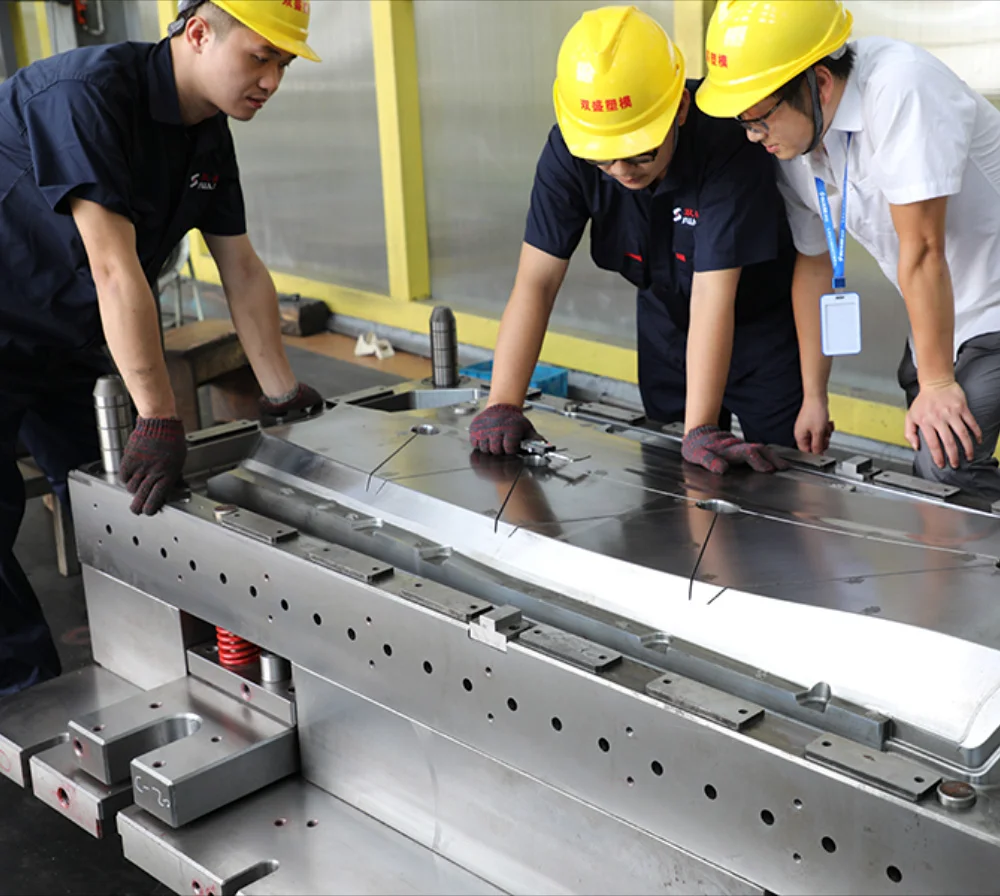
Before machining begins, the part geometry should be reviewed from a compression molding perspective.
Important factors include:
- Wall thickness.
- Rib geometry.
- Bosses and mounting features.
- Draft angles.
- Parting line location.
- Undercuts.
- Surface requirements.
- Dimensional tolerances.
- Material flow direction.
Early design review can identify features that may cause difficult filling, excessive local pressure, poor demolding, or unnecessary tooling complexity.
SMC Mould Material Selection
Mould material has a significant influence on tooling durability, machining accuracy, surface quality, and maintenance requirements.
The appropriate steel grade depends on:
- Production volume.
- Part size.
- SMC formulation.
- Mould temperature.
- Required surface finish.
- Expected mould life.
- Budget.
For production tooling, the mould material should provide sufficient hardness, dimensional stability, machinability, and resistance to the thermal and mechanical conditions of compression molding.
Precision Machining of SMC Moulds
Machining accuracy directly affects the final component.
Modern CNC machining can be used to produce complex mould cavities, ribs, bosses, transitions, and other three-dimensional features.
Critical machining areas may include:
- Parting surfaces.
- Cavity geometry.
- Core geometry.
- Mounting surfaces.
- Insert locations.
- Venting features.
- Heating channels.
A stable machining process helps reduce dimensional variation between the CAD model and the physical mould.
Surface Finish of SMC Moulds
Surface quality is especially important when the molded component has a visible Class-A or decorative surface.
The mould cavity may require several stages of finishing and polishing.
Surface preparation can influence:
- Part appearance.
- Gloss consistency.
- Release behavior.
- Surface defects.
- Cleaning requirements.
The required finishing level should be defined according to the final component rather than applying the same polishing standard to every mould.
Heating System Design
Temperature control is one of the most important considerations in SMC compression moulding.
The mould must reach and maintain the required processing temperature while minimizing temperature differences across the cavity.
A poorly designed heating system can contribute to:
- Uneven curing.
- Inconsistent surface quality.
- Different shrinkage rates.
- Dimensional variation.
- Longer cycle times.
Heating channels should therefore be positioned according to the mould geometry and expected heat distribution rather than simply placed wherever machining is convenient.
Why Temperature Uniformity Matters
SMC curing is sensitive to temperature.
If one area of the mould is significantly hotter or colder than another, different regions of the part may cure at different rates.
This can affect:
- Cure consistency.
- Surface appearance.
- Dimensional stability.
- Cycle time.
- Part performance.
For large SMC moulds, thermal analysis and practical temperature measurements can be useful during tooling development and trial molding.
Venting Design for SMC Compression Moulds
Air and volatile gases need to escape from the mould cavity during compression molding.
If venting is inadequate, trapped air can cause:
- Voids.
- Blisters.
- Surface marks.
- Incomplete filling.
- Local defects.
Venting should be considered according to the part geometry, material flow, cavity depth, and likely air-trap locations.
A professional mould manufacturer should treat venting as part of the overall mould-flow and process design rather than as a final machining operation.
Parting Line Design
The parting line determines how the mould opens and how the molded part is released.
A suitable parting line should consider:
- Part geometry.
- Draft direction.
- Flash location.
- Demolding.
- Surface appearance.
- Trimming requirements.
- Mould manufacturing complexity.
Poor parting line decisions can increase flash, complicate trimming, and make mould maintenance more difficult.
Draft and Demolding Design
SMC parts need to be released from the mould after curing.
Appropriate draft angles help reduce demolding resistance and minimize the risk of damaging the molded part.
Demolding design should also consider:
- Deep cavities.
- Vertical walls.
- Ribs.
- Bosses.
- Surface texture.
- Part shrinkage.
- Release agent behavior.
For complex components, the demolding strategy should be reviewed before mould machining.
Mould Flow and Charge Placement
The initial placement of SMC charge can influence how material flows through the cavity.
A mould manufacturer with practical compression molding experience can consider the relationship between:
- Charge size.
- Charge position.
- Flow distance.
- Rib arrangement.
- Thickness changes.
- Vent locations.
This helps reduce unnecessary flow length and potential areas of incomplete filling.
Trial Molding Is an Important Part of Tooling Development
A mould should not be considered finished simply because the machining process has been completed.
Trial molding provides an opportunity to verify the actual interaction between the mould, material, press, temperature, pressure, and process cycle.
During a trial, engineers may evaluate:
- Part filling.
- Flash.
- Surface quality.
- Demolding.
- Dimensional accuracy.
- Temperature uniformity.
- Cycle time.
Trial results can then be used to determine whether minor tooling or process adjustments are required.
Dimensional Inspection After Trial Molding
Dimensional inspection is particularly important for components with tight assembly tolerances.
Inspection may include:
- Overall dimensions.
- Critical mounting points.
- Hole positions.
- Flatness.
- Profile accuracy.
- Wall thickness.
- Key functional interfaces.
For complex components, coordinate measuring equipment or 3D scanning can be used to compare the molded part with the original CAD geometry.
How to Evaluate an SMC Mould Manufacturer in China
When comparing suppliers, buyers should look beyond the quotation price.
Useful evaluation criteria include:
- SMC mould design capability.
- Compression molding experience.
- CNC machining capability.
- Engineering team.
- Heating system design.
- Venting experience.
- Trial molding capability.
- Inspection equipment.
- Surface finishing capability.
- Project communication.
- After-sales support.
A supplier with strong engineering capability may reduce downstream production problems even if the initial tooling quotation is not the lowest.
What Information Should Buyers Provide?
Providing complete project information helps an SMC mould manufacturer develop a more accurate quotation and tooling proposal.
Useful information includes:
- 3D part data.
- 2D drawings.
- Material specification.
- Annual production volume.
- Press specifications.
- Required cycle time.
- Surface requirements.
- Dimensional tolerances.
- Expected mould life.
- Special inserts or features.
The more clearly these requirements are defined, the easier it is to determine the appropriate mould structure and manufacturing process.
SMC Mould Cost: What Influences the Price?
SMC mould pricing depends on much more than mould size.
Major cost factors include:
- Part complexity.
- Mould dimensions.
- Steel grade.
- Machining requirements.
- Number of cavities.
- Heating system.
- Hydraulic or mechanical mechanisms.
- Surface finishing.
- Special inserts.
- Inspection requirements.
For this reason, two moulds producing parts of similar size can have significantly different costs.
SMC Mould Manufacturer vs. General Tooling Supplier
Not every tooling supplier has the same level of experience with compression molding.
An SMC mould manufacturer should understand the relationship between tooling and material behavior.
This includes knowledge of:
- SMC material flow.
- Compression pressure.
- Cure behavior.
- Thermal management.
- Venting.
- Part shrinkage.
- Demolding.
- Surface finishing.
This process knowledge can be particularly valuable when developing large, complex, or high-volume SMC components.

Typical Applications of SMC Moulds
SMC compression moulds are used across multiple industries.
Automotive
- Body panels.
- Underbody components.
- Battery covers.
- Spare wheel wells.
- Roof components.
- Interior structures.
Electrical
- Electrical cabinets.
- Meter boxes.
- Distribution equipment housings.
- Insulating components.
Industrial
- Equipment housings.
- Machine covers.
- Protective enclosures.
- Structural panels.
Sanitary and Construction
- Bathroom components.
- Sanitary products.
- Composite panels.
- Building components.
Why DFM Matters for SMC Mould Development
Design for Manufacturing, or DFM, should be completed before final tooling design.
The purpose is not to change the product unnecessarily, but to identify geometry that could create manufacturing difficulties.
Typical DFM checks include:
- Draft angle analysis.
- Wall thickness review.
- Parting line analysis.
- Undercut identification.
- Rib and boss review.
- Material flow assessment.
- Demolding analysis.
- Potential air-trap locations.
Early DFM can reduce costly changes after the mould has already entered manufacturing.
Quality Control During SMC Mould Manufacturing
Quality control should continue throughout the tooling project rather than being limited to the final inspection.
Typical checkpoints include:
- Design review.
- Steel material verification.
- Rough machining inspection.
- Precision machining inspection.
- Heating and venting inspection.
- Mould assembly inspection.
- Surface finish inspection.
- Trial molding.
- Final dimensional inspection.
A structured inspection process helps ensure that the physical mould matches the approved engineering requirements.
How to Choose the Right SMC Mould Supplier
The right supplier should be evaluated according to the complete project rather than the initial quotation alone.
A practical evaluation can include:
- Review previous SMC mould projects.
- Confirm engineering and DFM capability.
- Check machining and inspection equipment.
- Discuss heating and venting design.
- Clarify trial molding arrangements.
- Define dimensional and surface requirements.
- Confirm expected tooling life.
- Review project communication and delivery planning.
This approach helps buyers identify a supplier that can support the complete tooling development process.
Conclusion
Finding the right SMC mould manufacturer in China requires more than comparing tooling quotations. The quality of an SMC mould depends on engineering design, material selection, machining accuracy, thermal management, venting, surface finishing, trial molding, and quality control.
A capable manufacturer should understand how the mould interacts with SMC material and the compression molding process. This allows tooling decisions to be made with production performance in mind rather than focusing only on mould fabrication.
For buyers developing new SMC components, an early engineering discussion with the mould supplier can help identify potential issues before tooling begins and create a more stable path from product design to mass production.
Frequently Asked Questions About SMC Mould Manufacturers in China
What should I look for in an SMC mould manufacturer in China?
Look for experience with SMC compression molding, strong DFM capability, precision machining, heating and venting design, trial molding, dimensional inspection, and reliable project communication.
How long can an SMC mould last?
Mould life depends on steel selection, material formulation, production conditions, maintenance, surface treatment, and production volume. The required tooling life should be defined during the project specification stage.
Why is heating important for SMC moulds?
Controlled mould temperature is important for consistent curing, dimensional stability, surface quality, and cycle time. Uneven temperature distribution can lead to inconsistent part performance.
Why does an SMC mould need venting?
Venting allows trapped air and gases to escape during compression molding. Inadequate venting can contribute to voids, blisters, surface defects, and incomplete filling.
Should an SMC mould be trial molded before delivery?
Yes. Trial molding provides an opportunity to verify filling, demolding, surface quality, dimensions, temperature behavior, and other important production characteristics before the tooling is released.
What information should I send when requesting an SMC mould quotation?
A 3D model, 2D drawing, material specification, production volume, press information, dimensional tolerances, surface requirements, and expected mould life can help the manufacturer prepare a more accurate tooling proposal.