
Many manufacturers focus primarily on SMC material selection, press tonnage, or production capacity when evaluating composite manufacturing projects. However, experienced engineers understand that the final performance of an SMC component is largely determined by the mold itself.
A well-engineered SMC compression mold does much more than shape a part. It controls material flow, heat transfer, gas evacuation, curing consistency, dimensional stability, surface appearance, and production efficiency. Whether producing automotive exterior panels, EV battery enclosures, sanitary products, or large structural components, mold design directly influences the quality and profitability of the entire manufacturing process.
How Thermal Management Controls Shrinkage and Warpage
One of the most critical functions of an SMC compression mold is maintaining uniform curing conditions. Because thermosetting resins cure through heat-activated chemical reactions, even small temperature variations can create significant differences in shrinkage behavior across a molded part.
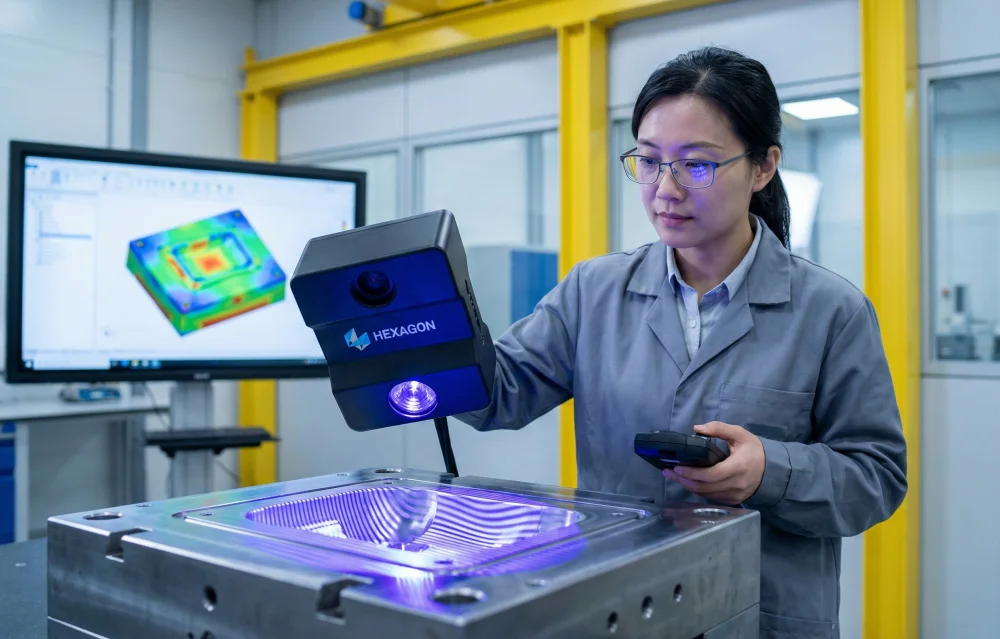
Advanced SMC compression mold designs utilize zoned oil-heating systems or independently controlled electrical heating circuits to maintain highly consistent mold temperatures. In demanding automotive and battery enclosure applications, temperature variation is often controlled within ±1°C to ensure synchronized curing throughout the entire component.
Without effective thermal management, manufacturers frequently encounter:
- Part warpage
- Dimensional instability
- Assembly misalignment
- Residual internal stress
- Reduced product consistency
At Suase, thermal simulations and optimized heating-channel layouts are integrated into the mold engineering process to achieve stable temperature distribution and predictable curing performance.
Why Precision Shear Edges Eliminate Manual Flash Trimming
Flash generation is one of the most common quality and cost challenges in composite molding. Excess material escaping through parting lines creates additional trimming operations, increases labor costs, and can negatively affect dimensional accuracy.
A properly engineered SMC compression mold incorporates precision shear-edge technology that controls material flow at the mold shut-off areas. By maintaining extremely tight closure tolerances, excess material is cleanly separated during compression rather than forming heavy flash around the component perimeter.
This engineering approach provides several advantages:
- Reduced manual trimming requirements
- Improved dimensional accuracy
- Higher production efficiency
- Lower post-processing costs
- Better compatibility with automated robotic handling systems
For high-volume automotive and industrial applications, minimizing flash can significantly improve overall manufacturing efficiency and reduce total production costs.
The Role of Vacuum Venting in Preventing Surface Porosity
Surface defects in SMC components often originate from trapped air, moisture, and volatile gases inside the mold cavity. If these gases cannot escape during compression, they may create porosity, blistering, burn marks, or visible surface imperfections.
An advanced SMC compression mold with venting design combines precision venting channels with vacuum-assisted evacuation systems to remove gases before final curing occurs.
Vacuum venting technology helps:
- Reduce porosity
- Prevent burn marks
- Improve surface smoothness
- Enhance paintability
- Increase structural integrity
For Class A automotive applications, effective venting design is often one of the most important factors in achieving premium surface quality.
How Mold Surface Finish Determines Class A Appearance
Achieving a true Class A surface requires much more than polishing the finished part. The quality of the mold surface directly determines the cosmetic appearance of every component produced.
An SMC compression mold for Class A surface applications must be manufactured with exceptional precision. Surface preparation, cavity machining accuracy, polishing quality, venting design, and temperature consistency all contribute to the final appearance.
Common Class A surface requirements include:
- Minimal fiber print-through
- Uniform gloss levels
- Smooth paint-ready surfaces
- Reduced waviness
- Excellent visual appearance
For automotive exterior panels, achieving Class A quality often requires mirror-polished mold cavities combined with highly controlled molding conditions.

Why Mold Rigidity Is Critical for Large EV Battery Enclosures
The rapid expansion of electric vehicle manufacturing has increased demand for large composite battery enclosures and structural components. These applications present unique challenges due to their size, complexity, and tight dimensional tolerances.
A high-performance SMC compression mold for EV battery enclosure production must maintain exceptional rigidity under substantial molding pressures. Any mold deflection can affect part geometry, sealing surfaces, assembly interfaces, and structural performance.
Key engineering considerations include:
- Mold structural strength
- Thermal stability
- Cavity alignment accuracy
- Uniform pressure distribution
- Long-term dimensional consistency
Robust mold construction enables manufacturers to produce large lightweight components that meet the demanding requirements of modern electric vehicle platforms.
How Mold Engineering Influences Long-Term Manufacturing Costs
While mold acquisition cost is often a major purchasing consideration, long-term production economics are typically influenced by engineering quality rather than initial tooling price.
A professionally engineered SMC compression mold can reduce total manufacturing costs through:
- Shorter cycle times
- Lower scrap rates
- Reduced maintenance requirements
- Improved first-pass yield
- Greater process stability
- Extended tooling life
As production volumes increase, these operational benefits often generate significantly greater value than the initial tooling investment itself.
Suase's Approach to SMC Compression Mold Engineering
As an experienced SMC compression mold manufacturer, Suase focuses on engineering solutions that improve both product quality and manufacturing efficiency.
Our development process includes:
- DFM analysis
- Material flow evaluation
- Thermal management optimization
- Vacuum venting design
- Precision CNC machining
- Surface finishing and polishing
- Mold testing and validation
By combining advanced tooling expertise with deep knowledge of composite processing, Suase delivers reliable mold solutions for automotive, EV, sanitary ware, infrastructure, and industrial applications.
Conclusion
Successful SMC molding depends on far more than material selection and press capacity. The design of the mold itself determines how material flows, how heat is transferred, how gases are evacuated, and how consistently parts are produced.
From thermal management and precision shear edges to vacuum venting and structural rigidity, every aspect of SMC compression mold engineering contributes to composite part quality. Manufacturers seeking superior performance, lower production costs, and long-term reliability should view mold design as a strategic investment rather than simply a tooling expense.