
As modern buildings increasingly emphasize durability, hygiene, and functional efficiency, laundry basins have become essential sanitary components in residential, commercial, and public facilities. At the core of reliable laundry basin production lies a critical manufacturing element — the laundry basin mold.
With the development of composite materials and advanced compression molding technologies, composite laundry basin molds have emerged as the preferred tooling solution for producing high-performance and long-lasting sanitary products.
Laundry Basins and Their Manufacturing Requirements
Laundry basins are widely used in utility rooms, hotels, hospitals, schools, and industrial cleaning areas. Unlike decorative washbasins, laundry basins must withstand frequent water exposure, detergents, mechanical impact, and long-term use.
These conditions place high demands on both composite material performance and mold engineering precision.
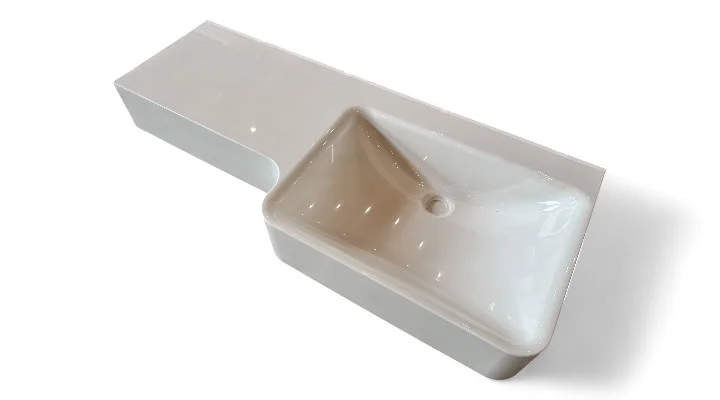
Why Composite Materials Are Ideal for Laundry Basins
Excellent Waterproof and Chemical Resistance
Composite materials such as SMC (Sheet Molding Compound) and BMC (Bulk Molding Compound) offer inherent resistance to moisture, detergents, disinfectants, and mild chemical agents.
This makes composite laundry basins suitable for high-humidity environments with frequent cleaning cycles.
High Strength with Lightweight Structure
Compared with ceramic or concrete products, composite laundry basins provide excellent mechanical strength while remaining lightweight, improving handling, installation efficiency, and long-term durability.
Hygienic and Easy-to-Clean Surfaces
The non-porous surface achieved through composite molding reduces dirt adhesion and bacterial growth, ensuring easy maintenance and compliance with hygiene standards.
The Importance of Laundry Basin Mold Quality
A high-quality composite laundry basin mold directly determines product consistency, surface finish, dimensional accuracy, and production efficiency.
For sanitary ware manufacturing, mold precision is a decisive factor in achieving stable mass production.
Key Design Considerations for Laundry Basin Molds
Precision Mold Structure
Laundry basin molds must ensure uniform wall thickness, accurate geometry, and reinforced stress areas to guarantee long-term product performance.
Optimized Mold Surface Finish
High-quality mold polishing and surface treatment enable smooth, consistent basin surfaces, reducing post-processing and enhancing product appearance.
Efficient Demolding Performance
Proper draft angles, parting line design, and surface coatings help reduce demolding resistance, prevent product damage, and improve production efficiency.
Compatibility with SMC and BMC Compression Molding
Composite laundry basin molds are typically designed for SMC and BMC compression molding, requiring excellent thermal stability and resistance to repeated pressure cycles.
Advantages of Composite Laundry Basin Molds
| Feature | Composite Laundry Basin Mold | Traditional Mold |
|---|---|---|
| Surface Finish | Excellent | Medium |
| Corrosion Resistance | High | Medium |
| Service Life | Long | Medium |
| Product Consistency | High | Medium |
| Maintenance Cost | Low | Higher |
Manufacturing Expertise Behind Reliable Laundry Basin Molds
At SUASE, laundry basin mold development focuses on composite material behavior, structural reinforcement optimization, and high-precision CNC machining.
Strict quality control throughout design, machining, and surface finishing ensures molds capable of long service life and stable, high-volume production.
Applications Beyond Laundry Basin Molds
The same composite mold technology can be extended to the production of:
- Washbasin molds
- Mop trough molds
- Utility sink molds
- Bathroom sanitary component molds
Conclusion
By combining advanced composite materials with precision mold engineering, composite laundry basin molds enable the production of durable, hygienic, and cost-effective sanitary products.
For manufacturers seeking long-term reliability and consistent quality, composite laundry basin molds represent a future-ready tooling solution.