
Achieving accurate dimensions is one of the most important challenges in SMC mold design. Unlike machining processes that directly produce final dimensions, compression molding involves material flow, curing reactions, thermal expansion, and shrinkage behavior that can influence the final part size.
For SMC (Sheet Molding Compound) components, proper consideration of shrinkage allowance during mold development is essential to achieve dimensional accuracy and stable production performance.
A well-designed SMC mold shrinkage allowance strategy allows engineers to compensate for material contraction during cooling and curing, reducing the need for repeated mold modification after trial production.
This article explains the principles of SMC shrinkage, factors affecting dimensional variation, and how professional mold manufacturers manage shrinkage compensation during compression mold development.
What Is SMC Mold Shrinkage Allowance?
SMC mold shrinkage allowance refers to the dimensional compensation added to the mold design to account for the expected shrinkage of the molded composite part after curing and cooling.
During compression molding, SMC material undergoes several physical and chemical changes:
- Material flow under pressure.
- Thermoset resin curing reaction.
- Temperature reduction after demolding.
- Internal stress release.
- Fiber and resin interaction.
These changes may cause the final molded component to become slightly smaller than the mold cavity dimensions.
Therefore, the mold cavity is usually designed slightly larger than the target product dimensions. This difference is known as shrinkage compensation or shrinkage allowance.
Why Shrinkage Allowance Is Important in SMC Mold Design
Incorrect shrinkage compensation is one of the common causes of dimensional problems in SMC compression molding.
If shrinkage is underestimated, molded parts may become undersized and fail assembly requirements. If shrinkage is overestimated, parts may become oversized and require additional correction.
Proper shrinkage allowance helps achieve:
- Accurate product dimensions.
- Stable assembly performance.
- Reduced mold modification cycles.
- Improved production efficiency.
- Lower tooling development cost.
For automotive, electrical, and industrial composite components, dimensional accuracy directly affects final product performance and customer acceptance.
Factors Affecting SMC Molding Shrinkage
SMC shrinkage is influenced by multiple factors. Engineers must consider material characteristics, product structure, and molding conditions when determining the correct compensation value.
1. SMC Material Composition
The composition of SMC material has a significant influence on shrinkage behavior.
Important material factors include:
- Resin type.
- Glass fiber content.
- Mineral filler content.
- Low profile additive system.
- Curing characteristics.
Higher fiber content generally reduces shrinkage because glass fibers restrict resin contraction during curing.
However, uneven fiber distribution may create local dimensional variation and affect product consistency.
2. Product Geometry and Wall Thickness
The geometry of the molded component also affects shrinkage behavior.
Factors include:
- Part thickness variation.
- Rib structures.
- Curved surfaces.
- Large flat areas.
- Reinforcement locations.
Large thin-wall components may experience different shrinkage patterns compared with small rigid parts.
For complex SMC components, engineers often use simulation analysis and previous project experience to predict dimensional changes.
3. Molding Temperature and Curing Conditions
Compression molding temperature directly affects resin curing and dimensional stability.
Important process parameters include:
- Mold temperature.
- Curing time.
- Compression pressure.
- Cooling conditions.
Insufficient curing may cause post-molding dimensional changes, while excessive temperature variation may increase internal stress and deformation.
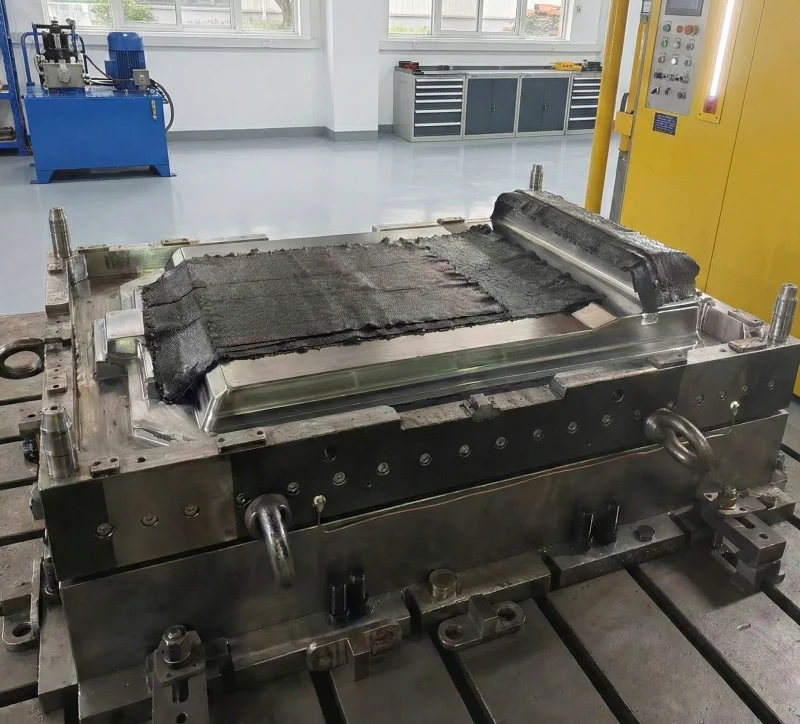
Typical Shrinkage Range in SMC Compression Molding
The shrinkage rate of SMC materials depends on formulation, reinforcement content, and application requirements.
In practical mold development, engineers usually determine shrinkage allowance based on:
- Material supplier technical data.
- Historical production experience.
- Prototype trial results.
- Dimensional measurement feedback.
There is no single universal shrinkage value suitable for all SMC materials. Each project requires evaluation based on actual material and product conditions.
How to Determine SMC Mold Shrinkage Allowance
Determining the correct SMC mold shrinkage allowance requires a combination of material data, product requirements, mold experience, and trial validation.
Unlike simple plastic injection molding, SMC compression molding involves thermoset curing and fiber reinforcement effects, making shrinkage prediction more complex.
Engineers normally consider the following factors when defining shrinkage compensation:
- Material shrinkage characteristics.
- Glass fiber orientation.
- Product size and geometry.
- Dimensional tolerance requirements.
- Molding temperature.
- Production experience with similar components.
The shrinkage allowance is typically determined during the mold design stage and verified through compression mold trials.
Shrinkage Compensation Methods in SMC Mold Design
Professional mold manufacturers use different compensation strategies to achieve accurate molded part dimensions.
1. Scaling Mold Cavity Dimensions
The most common method is adjusting cavity dimensions according to the expected shrinkage rate.
During CAD modeling, engineers enlarge critical mold dimensions to compensate for material contraction after curing.
This method requires accurate shrinkage prediction because excessive or insufficient compensation may create dimensional problems.
2. Local Dimensional Compensation
Not all areas of an SMC component shrink at the same rate. Complex parts may require localized compensation instead of uniform scaling.
Typical areas requiring special attention include:
- Mounting holes.
- Assembly interfaces.
- Rib structures.
- Large flat surfaces.
- Functional sealing areas.
Local compensation helps improve assembly accuracy and reduces secondary adjustment work after molding.
3. Mold Trial Based Adjustment
Even with advanced design methods, actual mold trials remain essential for final dimensional verification.
During trial production, engineers measure molded parts and compare actual results with product drawings.
Based on measurement data, adjustments may include:
- Mold surface modification.
- Dimensional polishing.
- Local machining correction.
- Process parameter optimization.
A professional trial-and-adjustment process ensures that the final SMC mold meets production requirements.
The Role of CAD and CAE Simulation in SMC Shrinkage Control
Modern SMC mold development increasingly uses digital engineering tools to predict material behavior before manufacturing the final tooling.
Computer-aided engineering (CAE) analysis can help evaluate:
- Material flow behavior.
- Fiber orientation.
- Pressure distribution.
- Temperature distribution.
- Potential deformation.
By analyzing these factors during the design stage, engineers can optimize mold structure and reduce unexpected dimensional problems during trial production.
For large automotive composite parts, simulation-based optimization can significantly reduce mold modification cycles and shorten project development time.
Common SMC Mold Shrinkage Problems and Solutions
Shrinkage-related issues are among the most common challenges during SMC mold validation. Understanding the root causes helps engineers develop effective solutions.
Problem 1: Molded Part Smaller Than Required Dimension
When the final component is smaller than the specification, insufficient shrinkage compensation is usually one possible reason.
Other possible causes include:
- Higher-than-expected material shrinkage.
- Excessive cooling contraction.
- Incorrect material selection.
- Insufficient mold compensation during design.
Possible solutions:
- Modify critical mold dimensions.
- Review material shrinkage data.
- Adjust process parameters.
- Optimize curing conditions.
Problem 2: Uneven Shrinkage Across the Part
Uneven shrinkage can cause dimensional variation, warpage, or assembly problems.
Common causes include:
- Uneven material distribution.
- Different wall thickness areas.
- Uneven temperature distribution.
- Fiber orientation differences.
Solutions may include:
- Improving material charge placement.
- Optimizing mold heating zones.
- Adjusting product structure.
- Improving mold flow design.
Problem 3: Warpage After Demolding
Warping is often related to uneven shrinkage and internal stress release after removing the part from the mold.
Potential causes:
- Unequal curing conditions.
- Residual stress inside composite material.
- Insufficient cooling stability.
- Improper part design.
Solutions include improving mold temperature balance, optimizing curing parameters, and modifying structural design.
Importance of Dimensional Inspection During SMC Mold Development
Accurate measurement is essential for validating shrinkage compensation effectiveness.
Common inspection methods include:
- Coordinate Measuring Machine (CMM).
- 3D optical scanning.
- Checking fixtures.
- Laser measurement systems.
Measurement results provide valuable feedback for mold correction and process optimization.
For precision SMC components, dimensional inspection should be performed throughout the mold development process, not only after final production.
Best Practices for Controlling SMC Mold Shrinkage
Effective shrinkage control requires cooperation between product designers, material suppliers, process engineers, and mold manufacturers. A successful SMC molding project depends on accurate prediction, proper compensation, and continuous validation.
The following practices help improve dimensional accuracy and reduce mold correction cycles.
1. Define Shrinkage Requirements at the Beginning of the Project
Shrinkage allowance should be considered during the initial product and mold design stage rather than after production problems occur.
Early communication between customers and mold engineers helps determine:
- Required dimensional tolerance.
- Material specifications.
- Production environment.
- Critical assembly areas.
- Performance requirements.
Early consideration reduces design changes and improves overall project efficiency.
2. Use Appropriate SMC Material Data
Different SMC formulations have different shrinkage characteristics. Using accurate material information is essential for reliable mold compensation.
Engineers should consider:
- Resin system.
- Fiber percentage.
- Filler content.
- Curing behavior.
- Thermal expansion characteristics.
Selecting suitable material data helps improve the accuracy of initial mold design.
3. Optimize Mold Temperature Control
Temperature uniformity has a direct impact on SMC part dimensions.
An optimized heating system helps achieve:
- Consistent curing performance.
- Reduced internal stress.
- Better dimensional stability.
- Improved surface quality.
Poor temperature distribution may cause different shrinkage rates in different areas of the component.
4. Validate Through Multiple Mold Trial Cycles
A single trial sample may not fully represent production conditions. Multiple validation cycles allow engineers to confirm process stability.
During repeated trials, engineers can optimize:
- Material loading method.
- Compression pressure.
- Curing time.
- Temperature settings.
- Mold compensation areas.
Systematic validation improves production reliability and reduces unexpected issues after mass production begins.
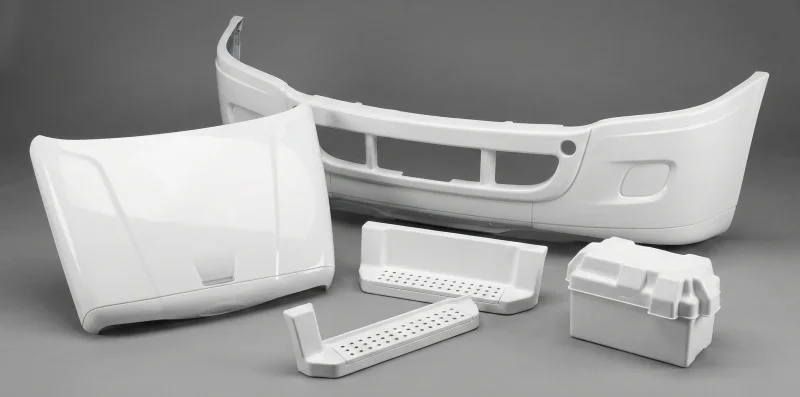
How SUASE Controls SMC Mold Dimensional Accuracy
As a professional composite mold manufacturer, SUASE understands that mold accuracy is not only determined by machining precision but also by engineering experience in material behavior and molding processes.
During SMC mold development, SUASE focuses on:
- Accurate product data analysis.
- Professional mold structure design.
- Shrinkage compensation optimization.
- Precision CNC machining.
- Surface finishing control.
- Mold trial verification.
- Dimensional inspection.
By combining advanced manufacturing technology with practical compression molding experience, SUASE helps customers achieve reliable tooling solutions for automotive, electrical, sanitary, and industrial composite applications.
SMC Mold Shrinkage Allowance in Different Applications
The importance of shrinkage control varies depending on the application requirements.
Automotive SMC Components
Automotive composite parts often require strict dimensional control because they must fit precisely with other vehicle systems.
Typical applications include:
- Battery covers.
- Body panels.
- Structural reinforcement parts.
- Interior components.
Incorrect shrinkage compensation may lead to assembly difficulties and additional production costs.
Electrical SMC Components
Electrical applications require stable dimensions and reliable insulation performance.
Examples include:
- Electrical enclosures.
- Meter boxes.
- Insulating components.
Precise mold design helps ensure proper fitting and long-term product reliability.
Industrial Composite Parts
Large industrial components may experience complex shrinkage behavior because of their size and structural complexity.
Professional mold compensation strategies are necessary to maintain product accuracy.
Frequently Asked Questions About SMC Mold Shrinkage Allowance
1. What is SMC mold shrinkage allowance?
SMC mold shrinkage allowance is the dimensional compensation added to the mold design to account for the shrinkage of the molded composite part after curing and cooling.
2. Why does SMC material shrink during molding?
SMC shrinkage occurs because of resin curing reactions, thermal contraction, internal stress release, and interaction between resin and reinforcement fibers.
3. Is there a fixed shrinkage value for all SMC materials?
No. Shrinkage depends on material formulation, fiber content, filler type, product structure, and molding conditions.
4. How do engineers compensate for SMC shrinkage?
Engineers compensate for shrinkage through CAD dimensional adjustment, local mold modification, simulation analysis, and mold trial verification.
5. Can incorrect shrinkage allowance affect product quality?
Yes. Incorrect compensation may cause dimensional errors, assembly problems, warpage, and increased mold modification costs.
6. How can SMC mold accuracy be improved?
Accuracy can be improved through proper material selection, accurate mold design, temperature control, precision machining, and systematic trial validation.
7. Why is mold trial important for SMC tooling?
Mold trials verify actual product dimensions and allow engineers to optimize compensation before mass production.
Conclusion
SMC mold shrinkage allowance is a critical factor in achieving accurate and stable compression molding production. Because SMC materials experience complex curing and shrinkage behavior, successful mold development requires careful analysis, engineering compensation, and trial validation.
By considering material characteristics, product structure, molding conditions, and manufacturing capability, engineers can reduce dimensional variation and improve tooling reliability.
A professional SMC mold manufacturer not only produces precision tooling but also provides engineering support throughout design optimization, mold trial, and production validation.
With advanced mold design experience and systematic quality control, SUASE delivers reliable compression mold solutions for customers requiring high-performance composite components.