
An SMC panel leaves the press with a recurring problem near a deep flange. The broad face looks acceptable, yet the same local area keeps holding up the trial. Increasing the temperature of the whole mould may change the good area without resolving the difficult one. Before another adjustment, the useful question is: does that location receive and recover heat in the way the part needs?
SMC mold heating design connects the heating circuit, the tool geometry and the moulding cycle. SUASE brings compression mould design and mould-trial capability to that problem. For a new tooling project, this provides a route from identifying a potentially difficult region to checking a design change against actual samples.
A Controller Setpoint Cannot Explain a Local Defect
Heat must travel through the tool to reach the moulding surface. A deep flange, an insert and a broad face can have different heat paths and recovery behaviour. SMC also needs time to flow and cure; a higher setpoint is therefore not a universal cure for an incomplete feature or a surface problem.
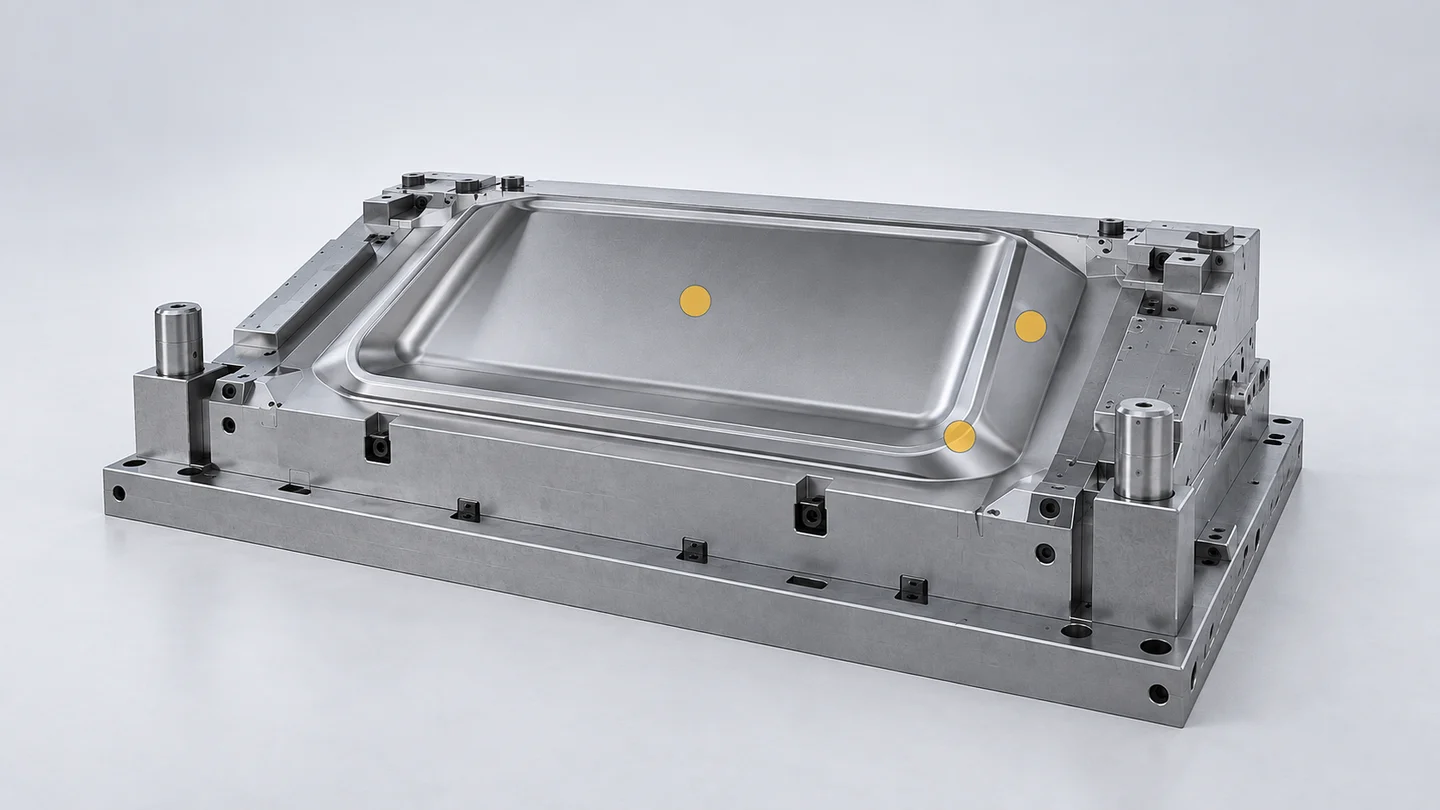
For a SUASE tooling project, the investigation can begin by linking the affected area on the sample to its location in the mould. Surface-temperature observations at agreed points and stages of the cycle help establish whether a thermal difference is repeatable. Comparing the same locations after loading and during recovery is more useful than comparing unrelated readings from the controller and the cavity.
This matters to the buyer because it gives the next change a reason. If the observations do not support a thermal cause, charge placement, venting and press conditions remain part of the investigation. A visible defect alone does not justify drilling another heating passage.
Put Heating Access into the Mould Design Before the Steel Is Cut
Consider a deep return flange beside a flat panel area. A nearby ejector or fastening feature may restrict where a circuit can pass. Moving the passage out of the way solves the mechanical clash, but may leave a longer heat path to the flange.
SUASE's design scope includes thermal-oil and steam circuits for thermoset composite tooling. That capability is relevant at the layout stage: circuit routing can be considered alongside inserts, ejection and tool structure, rather than treated as a separate drawing. A local concern can then be discussed as a specific geometry and supply problem, with the affected region identified in the design review.
The customer benefit is a clearer choice between feasible layouts before committing to machining. It does not mean every region needs an identical circuit. The appropriate arrangement follows the part, the compound and the available heating system.
A Sound Circuit Still Needs the Right Plant Connection
An oil-heated mould depends on circulation as well as supply temperature. If a branch has a restrictive path, the fact that it is connected does not show that it receives the intended flow. Steam circuits raise a different question: how will condensate leave the system as steam releases heat?
In a SUASE design review, these become practical interface decisions— circuit connections, supply and return arrangement, identification, and access for inspection. Resolving them with the customer's heating-equipment team helps prevent a well-made tool arriving with unclear installation requirements.
If a trial and the production plant use different supply conditions, record that difference. Matching the number on the temperature controller is not enough to establish equivalent mould behaviour.
Use the Mould Trial to Decide Whether the Change Helped
SUASE's in-house trial capability allows the mould and the resulting part to be considered together. For a heating concern, a useful agreed trial compares selected locations through repeatable cycles, then relates those observations to the same areas on the samples.
For example, if a flange's temperature recovery becomes more consistent after a circuit change, the next question is whether the relevant sample requirement also improves. If it does not, the investigation must continue beyond heating. This avoids treating a more attractive temperature record as proof of an acceptable part.
Trial scope can include the location map, measurement method, operating conditions and sample observations needed for the customer's acceptance decision. These are useful items to agree for the project, rather than assume from a general temperature-uniformity claim.
Bring SUASE the Difficult Region, Not Just a Target Temperature
If you are planning an SMC mould, contact SUASE with the part concept and the intended heating medium. If trial consistency is your concern, add one marked location and a description of when the problem appears.
That gives the discussion a concrete purpose: identify whether the tool layout, the heating interface or another moulding variable deserves attention, and define what the next sample needs to demonstrate.