
Carbon fiber molding has become one of the most advanced manufacturing technologies in modern industry. From lightweight automotive structures and aerospace components to industrial equipment and medical systems, molded carbon fiber parts are transforming the future of engineering.
Many manufacturers and product developers ask the same question:
Can you mold carbon fiber?
The answer is yes. Carbon fiber can be molded using advanced manufacturing processes such as compression molding, RTM molding, thermoforming, vacuum infusion, and autoclave composite molding.
These manufacturing technologies require precision-engineered carbon fiber molds, advanced composite tooling, and professional process control systems to achieve lightweight, high-strength composite components.
At SUASE MOULD, we specialize in manufacturing:
- Carbon fiber molds
- Compression molds
- Composite molds
- SMC molds
- BMC molds
- Thermoforming molds
- Advanced composite tooling systems
What Is Carbon Fiber Molding?
Carbon fiber molding is the process of shaping carbon fiber reinforced composite materials into high-performance structural components using heat, pressure, resin systems, and precision mold tooling.
Unlike traditional metal manufacturing, carbon fiber composite molding combines:
- Carbon fiber reinforcement materials
- Thermoset or thermoplastic resin systems
- Precision composite molds
- Compression tooling technology
- Controlled curing processes
The final molded carbon fiber products offer:
- Excellent strength-to-weight ratio
- Outstanding corrosion resistance
- Superior structural stiffness
- High fatigue resistance
- Thermal stability
- Lightweight engineering advantages
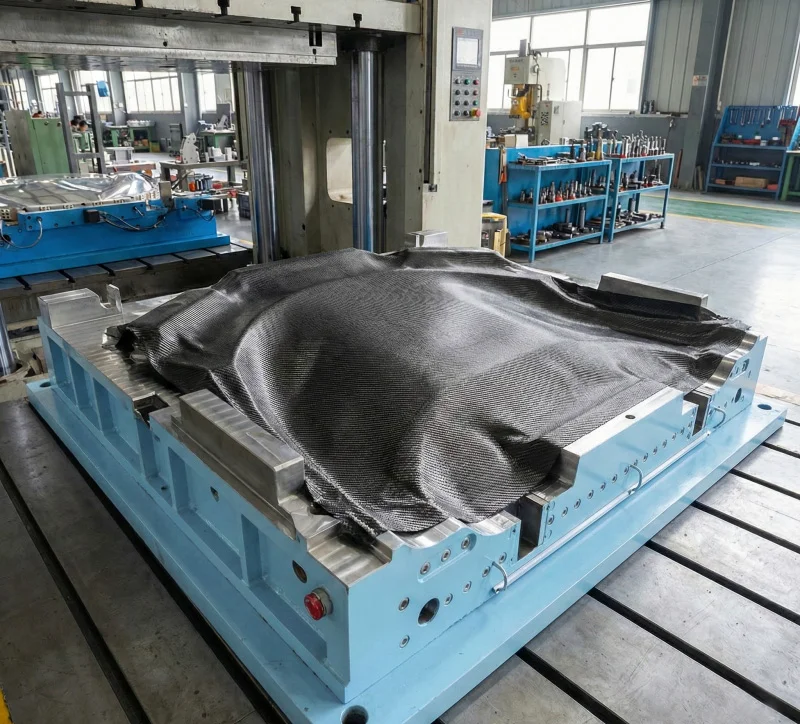
Can Carbon Fiber Be Compression Molded?
Yes. Carbon fiber compression molding is one of the fastest-growing technologies in advanced composite manufacturing.
In the compression molding process:
- Carbon fiber prepreg or composite charge material is loaded into the mold cavity
- The compression mold closes under controlled pressure
- Heat activates the resin system
- The material consolidates and flows into the mold geometry
- The composite cures into the final structural component
Compared with traditional hand lay-up manufacturing, carbon fiber compression molding provides:
- Faster production cycles
- High-volume manufacturing capability
- Excellent dimensional repeatability
- Improved structural consistency
- Reduced labor requirements
- Better surface quality
Modern compression molding technologies are widely used for:
- EV battery enclosures
- Automotive body panels
- Lightweight transportation systems
- Aerospace composite structures
- Industrial composite components
Main Carbon Fiber Molding Processes
Compression Molding
Compression molding is ideal for medium-to-high volume carbon fiber composite production.Advanced compression molds ensure stable pressure distribution, optimized curing efficiency, and precise dimensional accuracy.
RTM Molding
Resin Transfer Molding (RTM) uses dry carbon fiber preforms placed inside a closed mold cavity. Resin is injected under pressure to impregnate the fiber structure.
RTM molding provides:
- Excellent surface finish
- High structural consistency
- Reduced material waste
- Improved production automation
Thermoforming Composite Materials
Thermoforming uses heated thermoplastic composite sheets that are shaped using specialized thermoforming molds.
This process offers:
- Fast production cycles
- Lightweight manufacturing capability
- Recyclable thermoplastic advantages
- High production efficiency
Autoclave Composite Molding
Autoclave molding combines vacuum bagging and high-pressure curing to produce aerospace-grade carbon fiber composite structures with superior mechanical performance.
Why High-Precision Carbon Fiber Molds Matter
High-quality carbon fiber molds are critical for achieving:
- Dimensional precision
- Stable production consistency
- Uniform material flow
- Excellent surface finish
- Long tooling lifespan
- Optimized curing performance
Professional composite mold manufacturers must carefully engineer:
- Mold structures
- Heating systems
- Cooling channels
- Vacuum systems
- Pressure distribution
- Thermal expansion compensation
SUASE MOULD uses advanced CNC machining and precision manufacturing technologies to produce:
- Carbon fiber molds
- Compression molds
- SMC molds
- BMC molds
- Thermoforming molds
- Composite tooling systems
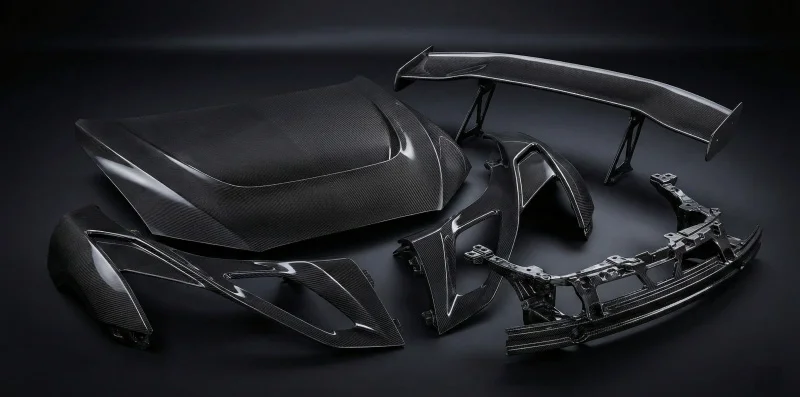
Industries Using Molded Carbon Fiber Parts
Automotive Industry
Automotive manufacturers increasingly use molded carbon fiber components for:
- Battery enclosure systems
- Roof panels
- Door structures
- Structural reinforcements
- Underbody protection systems
Aerospace Industry
The aerospace sector depends heavily on carbon fiber composite structures because of their lightweight performance and high structural strength.
Industrial Equipment
Carbon fiber composite parts are also widely used in:
- Robotics systems
- Automation equipment
- Machine covers
- High-speed industrial components
Medical Equipment Manufacturing
Carbon fiber composites provide lightweight performance, corrosion resistance, and high structural precision for advanced medical equipment systems.
Why Choose SUASE MOULD?
SUASE MOULD specializes in advanced:
- Carbon fiber mold manufacturing
- Compression tooling engineering
- Composite mold production
- SMC mold manufacturing
- BMC mold solutions
- Thermoforming tooling systems
We provide:
- High-precision tooling quality
- Long mold service life
- Professional engineering support
- Stable production performance
- Efficient project management
Conclusion
So, can you mold carbon fiber?
Absolutely. Modern carbon fiber molding technologies have become essential for lightweight engineering, advanced manufacturing, and high-performance industrial applications.
Whether using:
- Compression molding
- RTM molding
- Thermoforming
- Vacuum-assisted molding
- Autoclave composite manufacturing
success depends on:
- Advanced composite engineering
- High-quality carbon fiber molds
- Professional tooling systems
- Optimized manufacturing processes
SUASE MOULD continues to support global industries with advanced carbon fiber mold manufacturing, compression mold engineering, and high-performance composite tooling solutions.