
Technical guide for OEMs and Tier-1 suppliers on materials selection (SMC, CFRP, BMC, thermoplastics), design & safety requirements, manufacturing by compression mold, and future trends in EV battery housings.
Overview: Role of the EV Battery Enclosure
The EV battery enclosure (battery housing, battery pack enclosure) is a multifunctional subsystem that protects lithium-ion cells, integrates thermal management, contributes to crashworthiness, and provides environmental sealing and electromagnetic protection. As energy density rises and safety standards tighten, enclosure design and manufacturing are central to vehicle performance, reliability, cost, and recyclability.
1. Core Engineering Requirements
1.1 Structural & Crash Performance
Battery enclosures must resist mechanical intrusion, bottom impacts, and chassis loads. Enclosure stiffness and controlled deformation behavior are essential to prevent cell damage and thermal runaway propagation during collisions. Design validation commonly uses component-level crash simulations and sled testing.
1.2 Thermal Management
Efficient heat transfer and uniform cell temperature are critical for cycle life and charging speed. Modern enclosures often integrate cooling plates, channels, thermal interface materials, and insulation layers. Enclosure materials and geometry must support the thermal system without compromising structural integrity.
1.3 Fire, Electrical & EMI Safety
Battery housings must meet flame-retardancy standards (e.g., UL94 ratings where applicable), maintain electrical isolation, and provide electromagnetic interference (EMI) shielding for high-voltage systems. Composite enclosures can be engineered with conductive coatings or hybrid metal layers to satisfy EMI requirements.
1.4 Environmental Sealing & Durability
Typical targets include meeting IP67/IP68 ingress protection, chemical resistance to electrolytes and road fluids, UV stability, and long-term resistance to humidity and salt spray.
1.5 Weight & Manufacturability
Weight reduction directly improves vehicle range; therefore, composite and hybrid materials that reduce mass while maintaining safety are preferred. Manufacturability, cycle time, and cost per part determine production feasibility at scale.
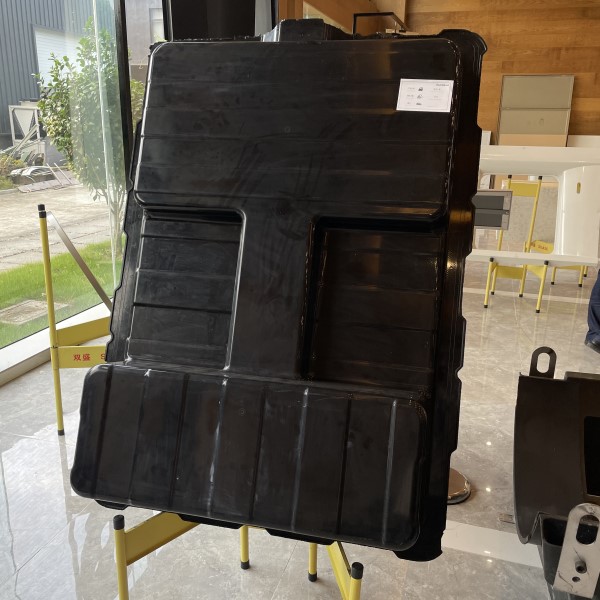
2. Material Solutions: Pros, Cons, and Typical Use Cases
| Material | Strengths | Limitations | Typical Use |
|---|---|---|---|
| SMC (Sheet Molding Compound) | Good flame resistance, Class-A surface, cost-effective, good impact resistance | Heavier than CFRP, limited to certain stiffness requirements | Upper covers, non-structural to semi-structural housings |
| CFRP (Carbon Fiber Reinforced Plastic) | Exceptional stiffness & strength, highest weight savings | Higher material & process cost, more complex repair/recycling | High-performance EVs, structural lower trays |
| BMC (Bulk Molding Compound) | High dimensional accuracy, flame retardant options | Best for smaller parts, less suitable for large trays | Electrical housings, module brackets |
| Thermoplastic Composites (LFT / D-LFT) | Fast cycles, recyclable, high impact resistance | Lower heat resistance vs. some thermosets (mitigations possible) | Large-volume trays, hybrid assemblies |
Material selection often results in hybrid designs (metal-composite sandwich, conductive coatings) to balance structural performance, EMI shielding, and manufacturability.
3. Manufacturing Technologies: Compression Mold & Complementary Processes
3.1 Compression Molding for EV Battery Covers
Compression molding (SMC/BMC compression) is widely used for upper covers and panels due to its ability to produce large, dimensionally stable components with integrated features (mounts, ribs, sealing flanges) and high fiber loading for mechanical performance. Typical advantages:
- Short cycle times suitable for high-volume production
- Good surface finish (reduces finishing/painting cost)
- Ability to mold complex geometries and integrated sealing surfaces
3.2 CFRP Processes (Autoclave, RTM, Compression Preforming)
CFRP lower trays and fully structural enclosures may be manufactured by Resin Transfer Molding (RTM), compression preforming, or automated fiber placement for premium applications. Process selection balances performance vs. cost and cycle time.
3.3 Thermoplastic Compression & Injection Hybrid Approaches
Thermoplastic composites (LFT/D-LFT) enable faster, recyclable production flows and are increasingly used in multi-material enclosures with metal reinforcements for mounts and crash rails.
3.4 Secondary Operations & Joining
Enclosures typically require: precision sealing (gasket in-mold or post-assembly), integration of coolant plates, fastener/insert installation, conductive coating or metal inserts for EMC, and leak testing. Design for assembly (DFA) reduces total cost.
4. Test Methods & Compliance
EV battery enclosures must pass multidisciplinary testing:
- Crash tests: full-vehicle and component sled tests for intrusion and crush resistance
- Thermal tests: heat soak, thermal cycling, and abuse tests to validate thermal runaway containment strategies
- Ingress protection: IP67/IP68 water immersion and dust tests
- EMC/ESD tests: to ensure safe operation of high-voltage systems
- Environmental aging: humidity, salt spray, and UV exposure
Comprehensive validation programs combine CAE simulation (CFD for cooling, FEA for crash) and physical testing to accelerate time-to-market.
5. Benefits of Composite EV Battery Enclosures
- Weight reduction: composite solutions can deliver 30–60% mass savings vs. equivalent metal designs in certain use cases.
- Integrated functionality: in-molded ribs, mounts, and sealing surfaces reduce part count and assembly time.
- Corrosion resistance: no galvanic corrosion and better chemical resistance vs. aluminum/steel.
- Design flexibility: complex shapes and tailored local reinforcement for targeted crash performance.
- Potential cost savings: at high volumes, compression molding with optimized cycle times offers attractive cost-per-part.
6. Practical Design Patterns & Example Architectures
Typical modern architectures combine:
- Composite upper cover (SMC or LFT) with integrated sealing flange and mounting bosses
- Composite or metal lower tray with crash-absorbing rails and coolant routing
- Hybrid inserts (metal bosses for fasteners, conductive strips for EMI)
Example: an SMC upper cover compression molded with integrated gasket groove, combined with an LFT lower tray and aluminum crash rails bonded and mechanically fastened—this architecture balances cost, manufacturability, and safety.
7. Best Practices for Production & Quality Control
- Early CAE integration: perform multi-physics simulations (structural, thermal, NVH) during concept design.
- Tooling precision: compression mold cavities must control flatness and dimensional tolerances to ensure sealing and assembly fit.
- Material process windows: tightly control cure profiles, pressure, and temperature for repeatable part quality.
- In-line inspection: optical dimensional checks, leak testing, and non-destructive evaluation (NDE) for composites.
- Design for recyclability: prefer thermoplastic composites or design for disassembly to meet circular economy goals.
8. Future Trends & Innovations
Key trends shaping EV battery enclosure technology:
- Adoption of thermoplastic composite enclosures to enable recyclability and faster cycle times.
- Hybrid multi-material structures combining metal rails with composite trays for optimal crash performance.
- In-mold sensors and digital twins for real-time process monitoring.
- Cell-to-pack and cell-to-chassis architectures that reduce module hardware and integrate the enclosure as structural chassis elements.
- Advanced flame-retardant SMC formulations with sub-minute cure cycles for high-volume production.
Conclusion
The EV battery enclosure is a mission-critical subsystem that strongly influences vehicle safety, performance, and range. Composite materials—when paired with robust manufacturing processes such as compression molding, RTM, and thermoplastic forming—offer a path to lightweight, high-performance, and cost-effective enclosures. For OEMs and Tier-1 suppliers, early cross-discipline engineering (CAE + materials + process) and design for manufacturability are essential to bring optimized battery enclosures to production at scale.
Ready to optimize your EV battery enclosure? Contact our engineering team for feasibility studies, material selection guidance, compression mold design, and pilot production.
Get technical support & quote