
Compression molding remains one of the most reliable and production-efficient processes for manufacturing high-strength composite components, especially for sectors requiring precision, stability, and consistent quality. As industries continue to adopt SMC, BMC, carbon-fiber-reinforced materials, and advanced thermosets, modern compression tooling and high-precision compression mold systems play an increasingly critical role in ensuring dimensional accuracy, surface quality, and long-term durability.
1. What Defines High-Performance Compression Tooling?
High-performance compression tooling is engineered to withstand high temperatures, controlled pressure loads, and continuous molding cycles while maintaining minimal thermal deformation. Tool steel selection, heat treatment processes, and surface coating technologies all contribute to the tool’s stability and longevity.
Modern tooling incorporates advanced cooling circuits, optimized venting paths, and precise cavity structures that collectively improve molding efficiency and reduce cure time. For thermoset molding such as SMC or BMC, the thermal uniformity of the mold directly influences fiber orientation, resin flow, and mechanical performance of the final part.

2. Precision Engineering in Compression Mold and Compression Mould Systems
A compression mold (or compression mould in British English) is designed to deliver consistent part geometry under controlled temperature and pressure. Precision machining technologies—such as 5-axis milling, EDM, CNC grinding, and high-polish finishing—are central to achieving class-A surface quality and tight tolerances.
Key engineering requirements include:
- Uniform distribution of heat across the entire mold cavity
- High structural rigidity to prevent cavity distortion
- Vent design that eliminates trapped gas during molding
- Balanced cavity layout for multi-cavity systems
- Wear-resistant surfaces for abrasive composite formulations
3. Material Compatibility: SMC, BMC, Carbon Fiber, and Advanced Thermosets
Modern compression tooling is expected to handle a wide range of materials, each requiring specific molding conditions. Sheet Molding Compound (SMC) and Bulk Molding Compound (BMC) are among the most common, benefiting from excellent mechanical strength and flame-retardant characteristics. These materials require molds capable of delivering stable thermal gradients and precise curing cycles.
For carbon-fiber compression molding, the tooling requirements become even more demanding. High-temperature resistance, thermal conductivity optimization, and anti-stick surface treatments all contribute to achieving lightweight and high-rigidity components suitable for automotive, aerospace, and energy sectors.
4. Process Efficiency and Cycle Time Optimization
One of the major advantages of advanced compression mold technology is the ability to significantly reduce cycle times without compromising part performance. This is achieved through:
- Enhanced mold heating systems with rapid thermal response
- Optimized resin flow paths for faster cavity fill
- Precision venting that prevents porosity and surface defects
- Automated loading and demolding systems
With optimized tooling design, manufacturers can achieve stable, repeatable production at high output volumes while maintaining consistent mechanical properties and dimensional accuracy.
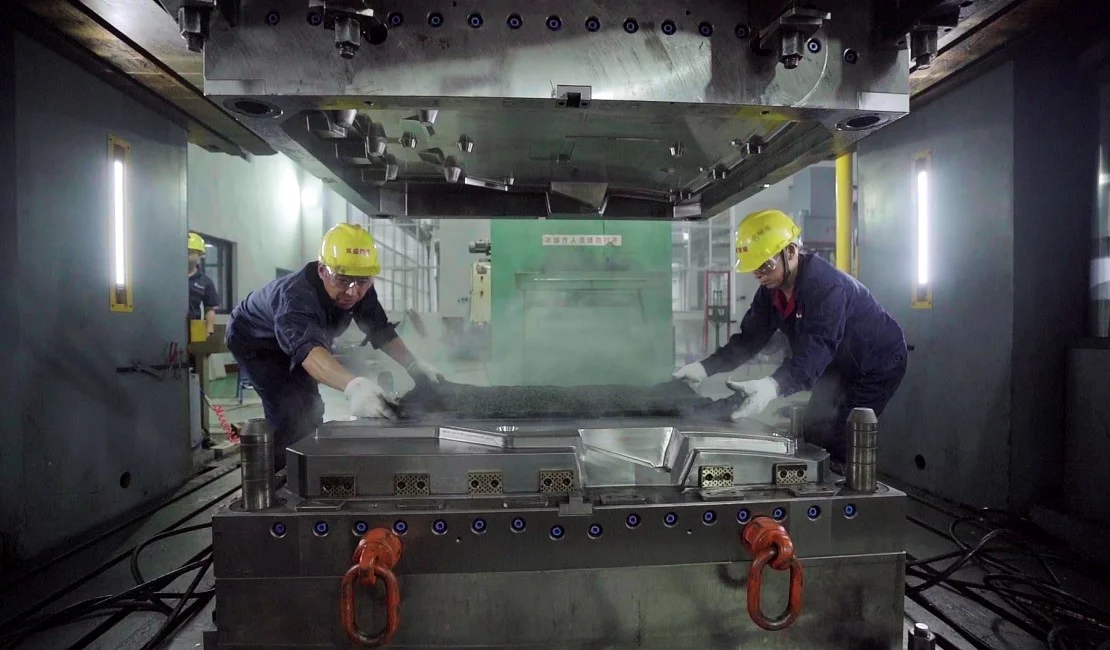
5. Industrial Applications of Compression Moulding Technology
Due to its efficiency and reliability, compression mould technology is widely used across multiple sectors:
- Automotive: structural panels, EV battery covers, exterior body components, under-hood parts
- Electrical: switchgear parts, insulation components, flame-retardant housings
- Consumer goods: appliance components, high-durability housings
- Energy and infrastructure: composite grids, enclosures, support structures
Each application requires customized mold design, precision tooling, and process-specific engineering to ensure performance under real-world operating conditions.
6. Future Trends in Compression Tooling and Mold Technology
Innovation in compression tooling continues to evolve rapidly. Trends shaping the next generation of molds include:
- Integration of digital simulation (CAE/CFD) for predicting resin flow and curing behavior
- Smart tooling with embedded temperature sensors and IoT monitoring
- Lightweight and hybrid tooling materials to improve energy efficiency
- Ultra-high precision machining for aerospace-grade composite parts
These advancements will enable higher productivity, reduced scrap rates, and improved sustainability across composite manufacturing operations.
Conclusion
The combination of advanced compression tooling, precision-engineered compression mold systems, and material-specific processing technologies has positioned compression molding as a leading manufacturing method for high-strength, lightweight, and dimensionally stable composite components. As industrial demands grow, ongoing innovation in tooling design, simulation, and automation will continue to strengthen the competitiveness of compression moulding across global markets.