
Introduction
The evolution of compression tooling technology has revolutionized precision manufacturing across multiple industries—from composite molding and automotive components to pharmaceutical tablet production. Suase Mould stands at the forefront of this innovation, delivering engineered Punch & Die Tooling and Tablet Compression Tooling systems designed for strength, consistency, and longevity.
In modern manufacturing, tooling precision determines product performance. Each micron of accuracy impacts how efficiently materials are formed, compressed, and released. This article explores the structure, working principle, material science, and application range of tooling in compression—and how Suase Mould integrates advanced machining technologies to lead the industry.
What is Compression, Punch & Die Tooling?
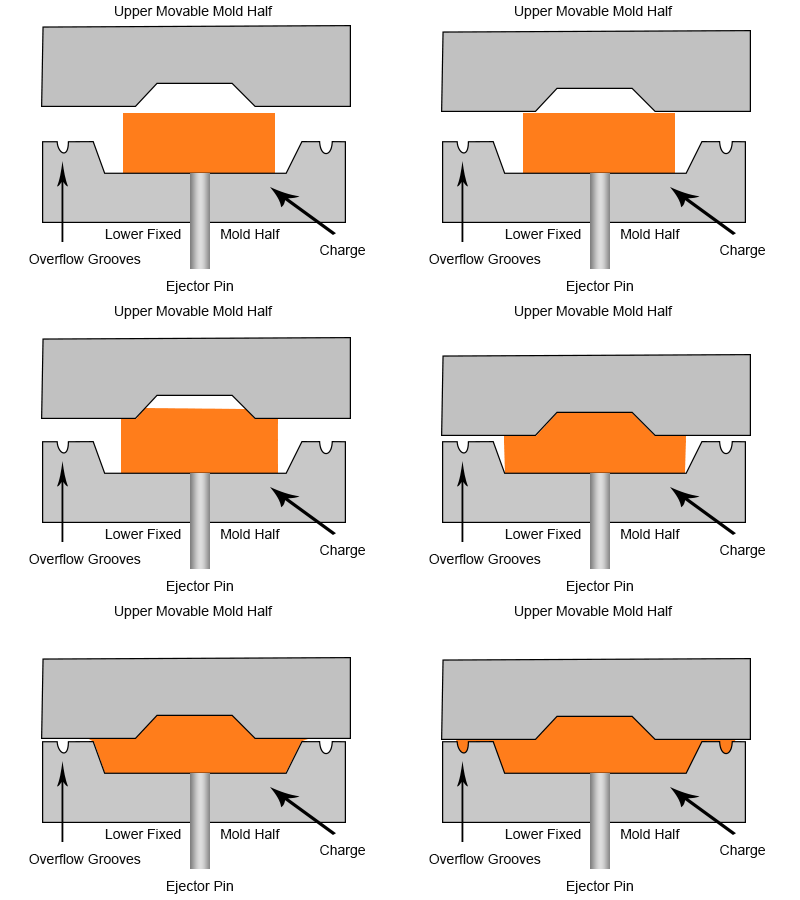
Compression tooling refers to a system of matched punches and dies that compact material into a defined shape under controlled pressure and temperature. The process relies on high-precision metal tooling to ensure uniform density, surface finish, and dimensional accuracy.
In punch and die tooling, the punch acts as a male part that fits into a female die cavity. Together, they apply compressive force to form materials like powder, resin, or composite sheets into exact geometries. These tools are fundamental to processes such as:
- Pharmaceutical tablet production
- SMC/BMC composite compression molding
- Powder metallurgy and ceramic forming
- Electrical and thermoset component manufacturing
Tool Design and Structure
A well-engineered compression tool consists of several critical elements: punches, dies, guide assemblies, and in some cases, preform holders and ejector systems. Each component must be designed for precise alignment, thermal stability, and mechanical endurance.
- Upper and Lower Punches: These apply the compressive force. Suase designs them with mirror-polished tips to reduce sticking and wear.
- Die Cavities: Hardened and ground to maintain micron-level dimensional stability during repetitive cycles.
- Die Table / Core Plate: Maintains alignment and transfers compressive load evenly.
- Cooling Channels: Integrated for heat control in thermoset or composite molding applications.
Materials and Surface Treatments
Tooling material selection is crucial for ensuring hardness, wear resistance, and dimensional accuracy. Suase Mould uses a combination of high-grade steels and coatings to achieve superior performance:
- Tool Steels: H13, D2, and DC53 steels for their high toughness and heat resistance.
- Stainless Steels: Used for pharmaceutical tooling to resist corrosion and contamination.
- Surface Treatments: Nitriding, TiN coating, CrN coating, and hard chrome plating enhance wear resistance and extend tool life.
- Polishing and Passivation: Ensures smooth surfaces and prevents material sticking during tablet compression or resin curing.
Applications of Compression and Tablet Tooling
The versatility of compression tooling lies in its ability to process different materials for vastly different industries:
- Pharmaceuticals: Tablet compression tooling ensures uniform dosage, clean embossing, and FDA-compliant surface finishes.
- Composites and Automotive: SMC and BMC molds rely on compression tooling for engine covers, EV battery enclosures, and structural panels.
- Electrical Components: Thermoset compression molds produce switchgear, insulators, and casings with precise electrical insulation properties.
- Powder Metallurgy: Punch and die sets form metal powders into gears, bushings, and sintered structural parts.
Engineering and Manufacturing Process at Suase Mould
Suase Mould applies an integrated approach to tooling manufacturing that combines advanced CAD/CAM modeling, CNC machining, EDM precision shaping, and coordinate measurement (CMM) inspection.
- 3D Modeling & Simulation: Finite element analysis ensures accurate stress and deformation prediction.
- Multi-Axis CNC Machining: Delivers tight tolerances and mirror surface finishes for punches and dies.
- Heat Treatment: Optimizes hardness and dimensional stability.
- Quality Control: ISO 9001 procedures, hardness testing, and dimensional verification for every component.
This precision engineering ensures that every compression tooling system meets the highest international standards.
Innovation in Tooling in Compression
Suase Mould continuously innovates in the field of tooling in compression by introducing intelligent manufacturing and sustainability-focused solutions:
- Digital Twin Simulation: Predicts cycle time, curing uniformity, and wear distribution.
- Smart Sensor Integration: Enables real-time temperature and pressure monitoring in molds.
- Recyclable Composite Tooling: Supports green manufacturing and material reusability.
- 3D-Printed Inserts: Reduces prototype lead times and enhances tooling efficiency.
The Future of Compression Tooling
With the rise of electric vehicles, lightweight composites, and high-precision pharmaceuticals, demand for advanced compression, punch & die tooling is expected to grow rapidly. Suase Mould is expanding its R&D to integrate hybrid metal-polymer tooling concepts, adaptive thermal control, and automated polishing technologies.
The company’s commitment to precision and sustainability ensures that its tooling solutions remain at the cutting edge of global manufacturing trends.
Conclusion
From tablet compression tooling that ensures pharmaceutical precision, to punch & die systems shaping the future of composites and thermosets, Suase Mould remains a trusted partner in delivering world-class tooling excellence. By combining material science, automation, and decades of expertise, Suase provides customers with durable, high-accuracy, and cost-efficient tooling systems for every compression challenge.
Contact Suase Mould to discover our complete range of Compression Tooling, Punch & Die Tooling, and Tablet Compression Tooling solutions.