
Compression mold maintenance is an important part of maintaining stable composite production. A well-designed compression mold can still experience surface wear, contamination, dimensional changes, venting problems, or mechanical issues if it is not inspected and maintained properly.
For SMC and other compression molded composite parts, regular tooling maintenance helps protect cavity surfaces, maintain dimensional accuracy, support consistent molding conditions, and reduce unexpected production interruptions.
The most effective approach is preventive maintenance rather than waiting until a visible tooling problem begins to affect the molded parts.
Why Compression Mold Maintenance Matters
Compression molds operate under repeated combinations of pressure, heat, material flow, and mechanical movement.
Over time, these conditions can lead to:
- Resin or material buildup.
- Surface contamination.
- Vent blockage.
- Parting surface wear.
- Guide component wear.
- Heating system problems.
- Corrosion.
- Dimensional changes.
- Demolding difficulties.
If these problems are not detected early, they can eventually affect part quality and production efficiency.
What Should Be Checked During Compression Mold Maintenance?
A practical maintenance program should cover both the molding surfaces and the mechanical systems of the tooling.
Key areas include:
- Mold cavity and core surfaces.
- Parting lines.
- Venting areas.
- Guide pins and bushings.
- Ejector or demolding mechanisms.
- Heating elements or channels.
- Temperature sensors.
- Hydraulic or pneumatic components where applicable.
- Fasteners and mounting points.
- Surface protection and corrosion condition.
1. Clean the Mold After Production
Regular cleaning is one of the simplest but most important maintenance activities.
During compression molding, resin, release-agent residue, fibers, flash, and other material deposits can accumulate on the tooling surface.
If buildup is allowed to continue, it may affect:
- Part surface appearance.
- Dimensional accuracy.
- Part release.
- Parting line sealing.
- Vent performance.
Cleaning methods should be compatible with the mold material and surface finish. Aggressive tools or abrasive methods should not be used unless they are known to be suitable for the specific tooling surface.
2. Inspect the Cavity Surface
The cavity surface directly influences the appearance and geometry of the molded component.
During maintenance, operators should look for:
- Scratches.
- Dents.
- Wear marks.
- Corrosion.
- Resin deposits.
- Polishing damage.
- Abnormal surface discoloration.
Small surface defects should be recorded and monitored rather than immediately repaired without determining their cause.
If a defect repeatedly appears in the same area of the molded part, the corresponding mold location should be inspected carefully.
3. Check the Parting Line
The parting line is an important functional area of a compression mold.
It must close sufficiently to control material flash while still allowing the mold to open and the part to be removed.
Maintenance inspections should check for:
- Material buildup.
- Damage to the sealing surface.
- Uneven contact.
- Wear.
- Foreign particles.
Excessive contamination at the parting line can prevent proper mold closure and increase flash around the molded component.
4. Keep Venting Areas Clean
Venting systems can gradually become blocked by resin, fibers, release-agent residue, or other contamination.
Blocked vents can make it more difficult for air and gases to escape during compression molding.
Possible consequences include:
- Surface defects.
- Voids.
- Blisters.
- Incomplete filling.
- Local molding inconsistencies.
Vents should therefore be inspected as part of routine tooling maintenance, especially when the production process begins to show unexplained surface or filling problems.
5. Inspect Guide Pins and Bushings
Guide components help maintain alignment between the upper and lower sections of the mold.
Repeated opening and closing cycles can gradually cause wear or contamination around guide pins and bushings.
Maintenance should check for:
- Wear.
- Scoring.
- Insufficient lubrication.
- Misalignment.
- Foreign material.
Worn guide components can affect mold alignment and may eventually contribute to uneven contact between mold surfaces.
6. Lubricate Moving Components Correctly
Moving components should be lubricated according to the mold design and the lubricant manufacturer's recommendations.
Depending on the tooling structure, lubrication may be required for:
- Guide pins.
- Bushings.
- Ejector mechanisms.
- Slides.
- Mechanical linkages.
- Other moving interfaces.
Excessive lubricant should be avoided because it can migrate onto molding surfaces and potentially affect the finished part.
7. Check the Heating System
Temperature control is critical in compression molding, particularly for SMC tooling.
Maintenance should include inspection of the heating system and temperature-control components.
Potential checks include:
- Heating elements.
- Heating channels.
- Thermocouples.
- Temperature sensors.
- Electrical connections.
- Temperature controller performance.
A heating system may continue to operate while gradually developing uneven temperature distribution. Therefore, checking only whether the mold can reach the target temperature is not always sufficient.
Why Temperature Uniformity Should Be Monitored
Uneven mold temperature can cause different regions of an SMC component to cure at different rates.
This may contribute to:
- Dimensional variation.
- Uneven surface quality.
- Inconsistent curing.
- Longer cycle times.
- Local defects.
If production data shows a gradual change in cure behavior or dimensional stability, the heating system should be included in the investigation.
8. Inspect Ejection and Demolding Components
Some compression molds use mechanical or hydraulic systems to assist part removal.
These components should move smoothly and consistently.
Maintenance checks can include:
- Ejector movement.
- Return position.
- Guide condition.
- Hydraulic or pneumatic leakage.
- Mechanical wear.
- Interference between moving components.
Abnormal demolding force should not automatically be treated as a process problem. It may indicate contamination, wear, insufficient draft, surface damage, or a problem with the demolding mechanism.
9. Check Mold Surface Protection
Compression molds that are not used for extended periods should receive appropriate corrosion protection.
Moisture and unsuitable storage conditions can cause surface corrosion, particularly around exposed metal areas.
Before storage, the mold should generally be:
- Cleaned.
- Dried.
- Inspected.
- Protected against corrosion.
- Stored in a suitable environment.
Before returning the tooling to production, the protective material should be removed or cleaned according to the tooling maintenance procedure.
10. Check Fasteners and Mold Assembly
Mold components, inserts, brackets, heating-system components, and other assemblies may be secured with mechanical fasteners.
Repeated thermal cycling and mechanical loading can gradually affect these connections.
Maintenance should therefore include visual inspection of:
- Bolts.
- Nuts.
- Clamps.
- Mounting plates.
- Inserts.
- Connection points.
Any tightening procedure should follow the tooling design requirements rather than applying excessive force.
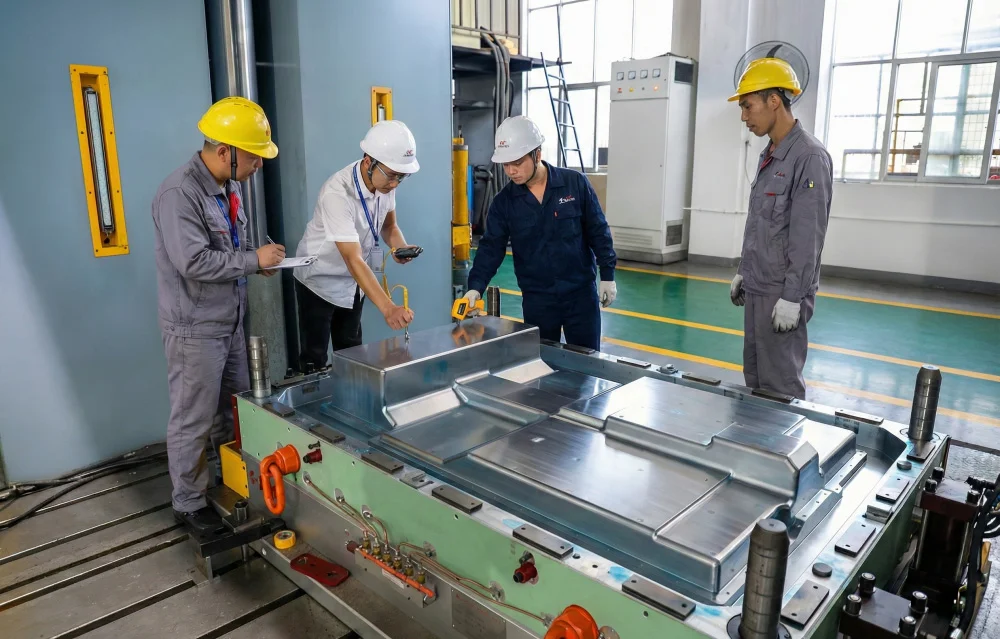
Compression Mold Maintenance Schedule
A useful maintenance program can be divided into different inspection levels.
Daily or Routine Checks
- Clean visible material buildup.
- Inspect cavity surfaces.
- Check parting lines.
- Observe demolding behavior.
- Check for abnormal noises or movement.
Periodic Checks
- Inspect vents.
- Check guide components.
- Inspect moving mechanisms.
- Check heating and temperature-control components.
- Inspect mounting hardware.
Scheduled Preventive Maintenance
- Detailed surface inspection.
- Dimensional verification where required.
- Heating-system performance verification.
- Inspection of wear components.
- Corrosion protection.
- Review of production history.
The exact interval should be established according to production volume, material type, mold design, operating temperature, and historical wear.
How to Identify Early Signs of Mold Problems
Production operators often notice changes in the molded parts before a tooling problem becomes visually obvious.
Potential warning signs include:
- Increasing flash.
- Changing surface gloss.
- New scratches or marks.
- Increasing demolding force.
- Inconsistent dimensions.
- Longer cycle time.
- Uneven curing.
- New voids or surface defects.
- Abnormal mold temperature behavior.
These symptoms should be recorded and investigated rather than corrected repeatedly through process adjustments without checking the tooling.
Compression Mold Maintenance and Mold Life
Proper maintenance can help extend tooling service life, but maintenance alone cannot prevent all forms of wear.
Mold life is influenced by:
- Steel selection.
- Material formulation.
- Production volume.
- Mold temperature.
- Compression pressure.
- Cleaning methods.
- Maintenance quality.
- Surface treatment.
A mold that is cleaned using inappropriate abrasive methods, operated outside its intended conditions, or stored incorrectly may experience premature surface damage.
Avoid Over-Cleaning the Mold Surface
Cleaning is necessary, but aggressive cleaning can itself become a source of tooling damage.
Improper tools or excessive abrasion can:
- Change surface roughness.
- Damage polished areas.
- Create scratches.
- Remove protective surface treatments.
- Change local dimensions.
Maintenance personnel should therefore use cleaning methods appropriate to the specific mold surface and contamination type.
Maintenance After a Long Production Run
After a long production campaign, a more detailed inspection is recommended.
The mold should be checked for:
- Material buildup.
- Surface wear.
- Blocked vents.
- Parting-line contamination.
- Guide component wear.
- Heating-system condition.
- Demolding mechanism condition.
Recording these findings creates a maintenance history that can be useful for planning future production and replacement of wear components.
Maintenance Records Are Part of Tooling Management
A maintenance record can provide valuable information about the actual operating condition of a compression mold.
Useful records include:
- Production cycles.
- Cleaning dates.
- Maintenance activities.
- Replacement components.
- Surface repairs.
- Temperature-related issues.
- Trial molding results.
- Dimensional inspection results.
This information can help identify recurring problems and support preventive maintenance planning.
Compression Mold Maintenance Checklist
| Inspection Area | What to Check |
|---|---|
| Cavity Surface | Contamination, scratches, wear, corrosion and surface condition |
| Parting Line | Material buildup, damage and contact condition |
| Venting | Blocked or damaged vents |
| Guide System | Wear, alignment and lubrication |
| Heating System | Heating elements, sensors and temperature uniformity |
| Demolding System | Movement, wear and abnormal resistance |
| Fasteners | Loose or damaged components |
| Corrosion Protection | Moisture, oxidation and storage condition |
How Proper Maintenance Supports Production Quality
The purpose of mold maintenance is not simply to keep the tooling visually clean.
A properly maintained compression mold helps maintain the conditions required for repeatable production.
This can support:
- Stable part dimensions.
- Consistent surface finish.
- Reliable demolding.
- Stable cycle times.
- Reduced unplanned downtime.
- Longer tooling service life.
For high-volume SMC production, even relatively small changes in tooling condition can become significant when repeated over thousands of molding cycles.
When Should a Compression Mold Be Repaired?
Not every surface mark requires immediate repair, but certain conditions should receive engineering attention.
Repair may be considered when there is:
- Significant cavity damage.
- Parting surface wear.
- Persistent dimensional deviation.
- Severe corrosion.
- Damaged venting features.
- Abnormal guide-system wear.
- Heating-system failure.
- Repeated demolding problems.
The repair method should be selected according to the affected area and the required dimensional and surface tolerances.
How Mold Design Affects Maintenance
Maintenance requirements begin with the original mold design.
A well-designed compression mold should provide reasonable access to:
- Venting areas.
- Heating components.
- Wear components.
- Moving mechanisms.
- Cleaning surfaces.
Serviceability should therefore be considered during tooling development rather than added only after production begins.
Conclusion
Compression mold maintenance is an important part of achieving stable and repeatable composite production. Regular cleaning, surface inspection, vent maintenance, heating-system checks, guide-component inspection, lubrication, corrosion protection, and dimensional monitoring can help identify tooling problems before they become major production issues.
For SMC compression molding, maintenance is especially important because the mold operates under repeated thermal and mechanical loading while handling abrasive fiber-reinforced material.
The best maintenance strategy is therefore preventive and data-based. By combining routine inspections with production records and periodic detailed checks, manufacturers can protect mold surfaces, reduce unexpected downtime, and extend the useful life of their compression tooling.
Frequently Asked Questions About Compression Mold Maintenance
How often should a compression mold be maintained?
The appropriate interval depends on production volume, material type, mold design, temperature, pressure, and previous wear history. Routine cleaning and inspection should be combined with scheduled preventive maintenance.
How should an SMC mold be cleaned?
The cleaning method should be selected according to the mold surface and type of contamination. Abrasive tools and aggressive cleaning methods should be avoided when they may damage the cavity finish or dimensions.
Why is vent cleaning important?
Blocked vents can prevent air and gases from escaping during molding, potentially contributing to voids, blisters, surface defects, and filling problems.
How can I tell if a compression mold is wearing out?
Increasing flash, dimensional changes, surface damage, higher demolding force, guide-component wear, and recurring molding defects can all be warning signs that the tooling should be inspected.
Does mold maintenance extend tooling life?
Proper maintenance can help reduce avoidable wear and corrosion and support longer service life. However, actual mold life also depends on material selection, production conditions, tooling design, and operating parameters.
Should compression mold maintenance be recorded?
Yes. Recording production cycles, inspections, cleaning, repairs, and component replacement helps identify recurring issues and makes preventive maintenance easier to plan.