
As composite materials continue to replace metals in electrical, automotive, industrial, and infrastructure applications, BMC Mold technology has become an essential part of modern compression molding manufacturing. High-quality Bulk Molding Compound (BMC) molds enable manufacturers to produce complex composite components with excellent dimensional accuracy, high mechanical strength, outstanding electrical insulation, and long service life.
Unlike conventional metal forming tools, a BMC compression mold must control not only product geometry but also resin flow, glass fiber distribution, mold temperature, venting efficiency, curing consistency, and production repeatability. Every stage of mold engineering directly influences the quality of the finished composite component.
Whether manufacturing electrical switchgear housings, automotive components, household appliance parts, lighting products, or industrial insulation components, selecting the right BMC mold solution is critical for achieving stable production and reducing manufacturing costs.
What Is a BMC Mold?
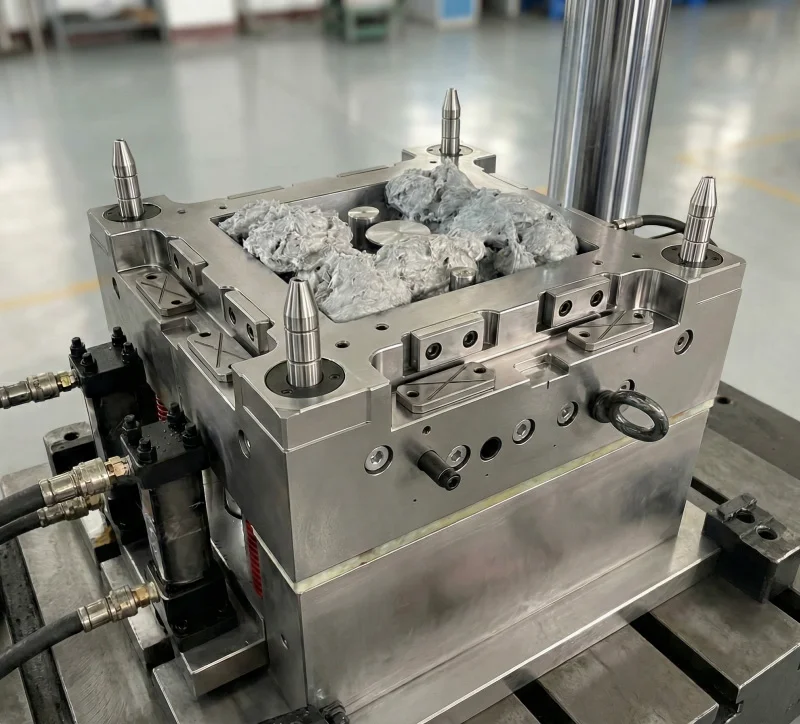
A BMC Mold, also known as a BMC Compression Mold, is a precision-engineered tooling system designed for molding Bulk Molding Compound under controlled heat and pressure.
Bulk Molding Compound is a thermosetting composite material consisting of polyester resin, chopped glass fibers, mineral fillers, curing agents, pigments, and various performance additives. During compression molding, a measured quantity of BMC material is placed into the mold cavity before the mold closes under high pressure. Heat activates the curing reaction, transforming the material into a rigid, high-strength composite part.
Unlike injection molding, compression molding allows glass fibers to remain relatively long, providing improved mechanical properties while maintaining excellent dimensional stability.
Why BMC Compression Molding Continues to Grow
Modern manufacturers increasingly choose BMC compression molding because it combines high production efficiency with outstanding material performance. Compared with many traditional manufacturing methods, BMC technology offers several advantages:
- Excellent electrical insulation properties
- High dimensional accuracy
- Superior corrosion resistance
- Outstanding heat resistance
- Excellent flame-retardant performance
- Low material shrinkage
- Stable production consistency
- High-volume manufacturing capability
- Excellent surface finish
- Long product service life
These characteristics have made BMC one of the preferred composite materials for electrical equipment, transportation systems, industrial products, and consumer appliances.
Typical Applications of BMC Mold
The versatility of BMC materials allows compression molds to produce thousands of different industrial components across multiple industries.
Electrical Industry
Electrical insulation remains one of the largest application areas for BMC molding. Typical products include:
- Circuit breaker housings
- Electrical switch boxes
- Motor insulation components
- Terminal blocks
- Cable distribution systems
- Electrical connectors
The excellent dielectric properties of BMC materials provide reliable insulation under demanding operating conditions.
Automotive Industry
Automotive manufacturers increasingly adopt BMC composite parts for applications requiring lightweight construction and heat resistance.
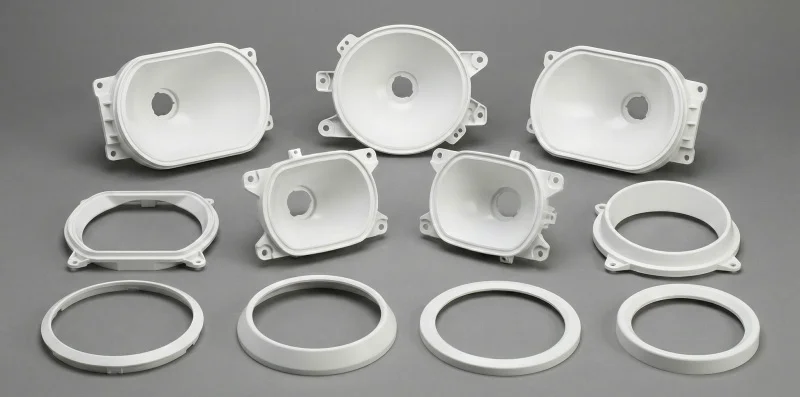
- Headlamp reflectors
- Sensor housings
- Battery insulation components
- Engine compartment parts
- Electrical protection covers
- Structural mounting brackets
The combination of thermal stability and dimensional precision makes BMC suitable for demanding automotive environments.
Industrial Equipment
Industrial applications include:
- Pump housings
- Mechanical covers
- Valve components
- Machine insulation parts
- Instrumentation housings
- High-temperature structural components
Household Appliances
Many household electrical products utilize BMC components because of their excellent heat resistance and flame-retardant performance.
- Cooker components
- Heating equipment
- Coffee machine parts
- Electric iron housings
- Kitchen appliance insulation parts
Difference Between SMC Mold and BMC Mold
One of the most frequently asked questions from customers is whether an SMC mold can also manufacture BMC products. Although both processes belong to compression molding, significant engineering differences exist.
| Comparison Item | BMC Mold | SMC Mold |
|---|---|---|
| Raw Material | Bulk Molding Compound (Bulk Form) | Sheet Molding Compound (Sheet Form) |
| Material Flow | Higher Flowability | Lower Flowability |
| Fiber Length | Short Glass Fiber | Long Glass Fiber |
| Typical Products | Electrical Components | Automotive Panels |
| Wall Thickness | Generally Thinner | Generally Larger Structural Parts |
| Mold Venting | Higher Venting Requirement | Moderate Venting Requirement |
| Runner Design | More Critical for Uniform Filling | Depends on Charge Pattern |
| Surface Finish | Excellent | Excellent |
Although their basic molding principles are similar, BMC molds require specialized engineering solutions because Bulk Molding Compound flows differently inside the cavity and cures under different processing conditions. Simply modifying an SMC mold is rarely sufficient to achieve optimum BMC production.
Why Mold Engineering Determines Product Quality
Many manufacturers focus primarily on selecting high-quality BMC materials, yet the mold itself often has a greater influence on the final product than the raw material.
A professionally engineered BMC mold controls:
- Material flow behavior
- Glass fiber distribution
- Curing consistency
- Temperature balance
- Venting efficiency
- Dimensional accuracy
- Surface appearance
- Production cycle time
- Tool service life
Poor mold engineering frequently results in short shots, trapped air, burn marks, excessive flash, warpage, inconsistent dimensions, and unnecessary production downtime.
For this reason, experienced BMC mold manufacturers invest significant effort in engineering analysis before machining begins. Product geometry, material characteristics, cavity layout, runner design, venting strategy, and temperature control must all work together to achieve stable, repeatable production.
The Complete Development Process of a Custom BMC Mold
Developing a custom BMC mold involves much more than machining steel blocks. A professional project typically follows a structured engineering workflow:
- Customer product analysis
- Design for Manufacturability (DFM)
- Mold flow and structural evaluation
- 3D mold design
- Mold steel selection
- CNC machining
- EDM and precision finishing
- Assembly and fitting
- Mold trial and process optimization
- Customer approval and production support
Each stage directly affects tooling performance, production efficiency, and long-term mold reliability.
In the following sections, we will explore the most critical engineering topics, including BMC mold runner design, venting systems, temperature control, mold trials, maintenance, and how to choose a reliable BMC mold manufacturer.
BMC Mold Design: Engineering for Stable and Efficient Production
A successful BMC mold design is far more than creating the external shape of a product. Every engineering decision—from cavity layout and runner design to venting and temperature control—directly influences part quality, production efficiency, and mold service life.
Unlike conventional metal forming tools, BMC compression molds must manage the flow of a thermosetting composite material containing resin, fillers, and chopped glass fibers. The mold must guide the material smoothly into every feature of the cavity while ensuring uniform curing throughout the molding cycle.
Modern BMC mold design focuses on balancing mechanical performance, manufacturing efficiency, dimensional accuracy, and long-term tooling reliability.
Key Design Principles for BMC Compression Molds
Before detailed mold construction begins, engineers evaluate several critical factors:
- Product geometry and wall thickness distribution
- Material flow characteristics
- Glass fiber orientation
- Shrinkage behavior
- Demolding direction
- Draft angle requirements
- Insert locations
- Production volume
- Required surface finish
A comprehensive Design for Manufacturability (DFM) review allows potential production issues to be identified before machining begins, reducing tooling modifications during mold trials.
BMC Mold Runner Design: Achieving Uniform Material Flow
One of the most important aspects of BMC mold runner design is ensuring that Bulk Molding Compound fills every area of the cavity evenly. Because BMC contains chopped glass fibers and highly filled resin systems, poor runner design may create unstable flow patterns that affect both appearance and mechanical performance.
A properly designed runner system should:
- Distribute material uniformly
- Reduce flow resistance
- Minimize pressure loss
- Prevent fiber segregation
- Reduce weld lines
- Support balanced cavity filling
Balanced flow is particularly important for products containing thin ribs, deep bosses, electrical terminals, and complex internal structures.
Runner Size Optimization
Runner dimensions should be optimized according to product size, cavity number, material viscosity, and molding pressure.
Excessively small runners increase flow resistance and pressure requirements, while oversized runners increase material waste and may produce uneven curing.
Gate Position Selection
Gate location has a major influence on fiber orientation and material distribution.
Engineers generally position gates where material can spread naturally toward all sections of the cavity while avoiding unnecessary flow intersections.
Proper gate placement helps improve dimensional stability and reduces the risk of sink marks and incomplete filling.
BMC Mold Venting Design
During compression molding, air trapped inside the cavity must escape before the resin completely fills the mold. Without an effective venting system, compressed gases may generate defects that reduce product quality.
A well-designed BMC mold venting system allows air, moisture, and volatile gases to exit the cavity while preventing excessive material leakage.
Common Problems Caused by Poor Venting
- Burn marks
- Air traps
- Gas porosity
- Short shots
- Surface pinholes
- Incomplete filling
- Excessive flash
Proper vent placement is especially important around deep ribs, enclosed cavities, and areas where multiple material flow fronts meet.
Optimizing Vent Locations
Engineers typically position vents at the final filling locations where trapped air naturally accumulates.
For complex electrical products containing numerous ribs and inserts, multiple venting paths may be required to maintain stable production.
Temperature Control in BMC Molds
Temperature uniformity plays a decisive role in BMC compression molding because thermosetting resins cure only within a controlled temperature range.
Uneven mold temperatures may produce inconsistent curing, dimensional variation, excessive shrinkage, or poor surface quality.
Professional BMC molds therefore incorporate carefully designed heating systems capable of maintaining stable temperatures throughout the entire cavity.
Benefits of Uniform Temperature Distribution
- Consistent curing reaction
- Improved dimensional accuracy
- Reduced internal stress
- Higher production repeatability
- Better surface appearance
- Shorter molding cycles
Heating Methods
Depending on production requirements, BMC molds may utilize:
- Electric cartridge heaters
- Oil heating systems
- Steam heating
- Integrated multi-zone temperature control
Large molds frequently divide the cavity into multiple heating zones, allowing precise temperature adjustment across different product areas.
Mold Steel Selection
Selecting the appropriate mold steel significantly affects machining quality, polishing performance, thermal conductivity, wear resistance, and overall mold service life.
The optimal material depends on production volume, product complexity, resin abrasiveness, and expected maintenance intervals.
Common tool steels used for BMC molds include hardened alloy steels capable of maintaining dimensional stability under repeated thermal cycling.
Proper heat treatment further improves hardness, wear resistance, and long-term machining accuracy.
Precision CNC Machining for BMC Molds
Modern BMC molds require extremely high machining precision to achieve consistent part dimensions and excellent surface quality.
Manufacturing typically combines several advanced processes:
- High-speed CNC milling
- Five-axis machining
- Electrical discharge machining (EDM)
- Precision grinding
- Mirror polishing
- CMM dimensional inspection
High machining accuracy minimizes mold fitting adjustments while improving assembly precision and reducing trial time.
Surface Finish Requirements
Many BMC components are visible products used in electrical equipment, automotive systems, and consumer appliances. Consequently, mold surface quality directly affects the appearance of the finished component.
Professional polishing techniques help eliminate machining marks while producing smooth cavity surfaces that improve resin flow and facilitate demolding.
For high-gloss products, mirror polishing combined with precision cavity machining enables manufacturers to achieve excellent cosmetic quality without extensive secondary processing.
Integrating Simulation into Mold Engineering
Leading BMC mold manufacturers increasingly incorporate digital engineering tools before production begins.
Computer simulation allows engineers to evaluate:
- Material flow behavior
- Pressure distribution
- Temperature balance
- Curing characteristics
- Potential air traps
- Fiber orientation
- Part deformation
- Cycle time optimization
By validating the design virtually, manufacturers can reduce mold modifications, shorten development cycles, and improve first-trial success rates.
Why Engineering Quality Matters More Than Tooling Cost
Some buyers evaluate suppliers primarily based on mold price. However, the long-term production cost of a BMC mold is determined more by engineering quality than by its initial purchase price.
A well-engineered mold reduces scrap rates, minimizes machine downtime, shortens molding cycles, and extends tooling life. Over years of production, these improvements often generate significantly greater savings than the difference in initial tooling investment.
For this reason, experienced BMC mold suppliers emphasize engineering optimization throughout the entire mold development process rather than focusing solely on manufacturing cost.
BMC Mold Trial: Validating Tool Performance Before Mass Production
A successful BMC mold trial is one of the most important milestones in mold development. Before a mold is delivered for production, comprehensive testing is required to verify that every engineering objective has been achieved.
The purpose of mold trial is not simply to produce sample parts. Instead, it is a systematic process for evaluating material flow, cavity filling, temperature distribution, curing behavior, dimensional accuracy, cycle time, and overall mold reliability.
Professional mold manufacturers typically conduct several trial rounds to optimize molding parameters before customer approval.
Items Evaluated During Mold Trial
- Complete cavity filling
- Material flow balance
- Part weight consistency
- Surface finish quality
- Flash control
- Demolding performance
- Cycle time stability
- Temperature consistency
- Repeatability over multiple production cycles
The data collected during mold trials provides valuable feedback for final process optimization and ensures stable mass production after mold delivery.
BMC Mold Acceptance Standards
After mold trial optimization, the tooling enters the BMC mold acceptance stage. Acceptance criteria should be established before manufacturing begins to ensure both supplier and customer evaluate the mold using the same technical standards.
Typical Acceptance Criteria
- Product dimensions within specified tolerances
- Qualified surface appearance
- No visible sink marks or voids
- No excessive flash
- Stable production over continuous molding cycles
- Reliable mold opening and closing operation
- Cooling and heating systems functioning correctly
- All ejector mechanisms operating smoothly
- Complete technical documentation provided
Professional acceptance procedures reduce production risks and provide confidence before transferring the mold into volume manufacturing.
Common BMC Molding Defects and Their Causes
Even with high-quality raw materials, improper mold design or incorrect processing conditions may produce molding defects. Understanding the root causes helps manufacturers improve production efficiency and reduce scrap rates.
| Defect | Possible Cause | Engineering Solution |
|---|---|---|
| Short Shot | Poor material flow or insufficient pressure | Optimize runner design and molding parameters |
| Air Trap | Insufficient venting | Improve vent layout and vent depth |
| Flash | Worn parting surfaces or excessive pressure | Repair sealing surfaces and adjust process parameters |
| Burn Mark | Compressed trapped gas | Enhance cavity venting |
| Warpage | Uneven curing or temperature imbalance | Improve heating uniformity and part design |
| Surface Porosity | Gas retention during curing | Optimize venting and material charging |
A systematic analysis of molding defects allows engineers to distinguish between tooling issues and processing problems, reducing unnecessary mold modifications.
BMC Mold Maintenance for Long-Term Production
Regular BMC mold maintenance is essential for preserving dimensional accuracy, extending tooling life, and maintaining stable production quality.
Thermosetting composite materials generate heat, pressure, and chemical residues during molding. Without proper maintenance, these factors may gradually reduce mold performance.
Recommended Maintenance Procedures
- Clean mold cavities after production
- Inspect vent grooves regularly
- Check heating system performance
- Lubricate guide pillars and moving components
- Inspect ejector pins for wear
- Verify cavity dimensions periodically
- Apply corrosion protection during storage
Preventive maintenance minimizes unexpected downtime and helps maintain consistent product quality over thousands of molding cycles.
BMC Mold Repair and Refurbishment
Even high-quality molds eventually require servicing after long-term production. Professional BMC mold repair restores tooling performance while extending operational life.
Typical repair services include:
- Parting surface restoration
- Cavity polishing
- Vent cleaning and re-machining
- Runner modification
- Heating element replacement
- Guide system refurbishment
- Ejector system repair
- Surface welding and precision re-machining
Well-planned refurbishment often allows manufacturers to continue using existing molds instead of investing in completely new tooling.
Factors Affecting BMC Mold Quotation
One of the most frequently asked questions from buyers concerns the cost of a custom BMC mold. However, there is no standard mold price because every project has unique engineering requirements.
Several technical factors influence the final quotation:
- Overall product dimensions
- Product complexity
- Number of cavities
- Mold steel specification
- Heating system configuration
- Surface finish requirements
- Automation compatibility
- Production volume
- Expected mold lifetime
- Testing and validation requirements
Providing complete 2D drawings, 3D CAD files, annual production volume, material specifications, and quality requirements enables mold manufacturers to prepare more accurate quotations.
The BMC Mold Development Workflow
Professional mold suppliers generally follow a standardized development process to ensure project quality and delivery performance.
- Technical discussion and requirement analysis
- Product feasibility evaluation
- Design for Manufacturability (DFM)
- 3D mold design
- CAE flow simulation (if required)
- Mold steel procurement
- Precision CNC machining
- EDM and finishing operations
- Mold assembly and fitting
- Mold trial and process optimization
- Customer inspection and approval
- Production support and after-sales service
A structured workflow minimizes project risks while improving communication between customers and mold manufacturers throughout development.
Why Continuous Technical Support Matters
Delivering a mold is only the beginning of a successful manufacturing partnership. Ongoing engineering support helps customers optimize production efficiency, improve product quality, and resolve technical challenges throughout the mold's service life.
Experienced BMC mold manufacturers provide assistance with process optimization, spare parts supply, maintenance guidance, production troubleshooting, and future tooling upgrades. This long-term support helps maximize tooling value and ensures reliable performance in demanding production environments.
How to Choose a Reliable BMC Mold Manufacturer
Selecting the right BMC mold manufacturer is one of the most important decisions in any composite molding project. While mold price is always a consideration, long-term production performance, tooling life, engineering capability, and technical support usually have a much greater impact on the total manufacturing cost.
An experienced supplier should provide comprehensive engineering services throughout the entire project lifecycle—from product evaluation and mold design to mold trials, production support, and after-sales service.
Key Factors to Evaluate
- Experience in BMC compression mold design
- In-house CAD, CAM, and CAE engineering capabilities
- Advanced CNC machining and EDM equipment
- Well-established mold trial procedures
- Stable quality management system
- Strong project management and communication
- International export experience
- Responsive technical support after mold delivery
Choosing a supplier with proven engineering expertise helps reduce project risks, improve production efficiency, and shorten time-to-market.
Why Professional Engineering Is More Important Than Low Mold Cost
Many buyers compare quotations from several suppliers and naturally focus on the lowest price. However, a lower initial tooling cost does not necessarily result in lower production costs.
A professionally engineered BMC mold can deliver significant long-term benefits, including:
- Reduced molding defects and scrap rates
- Shorter production cycles
- Improved dimensional consistency
- Longer mold service life
- Lower maintenance costs
- Higher overall production efficiency
When evaluated over hundreds of thousands of molding cycles, engineering quality often provides a much greater return on investment than the initial tooling price.
Suase Mould's BMC Mold Solutions
Suase Mould specializes in the design and manufacture of high-quality BMC Compression Molds for customers worldwide. With years of experience in composite tooling, our engineering team delivers customized mold solutions for electrical components, automotive parts, industrial products, household appliances, and other composite applications.
Our services include:
- Product feasibility analysis
- Design for Manufacturability (DFM)
- 3D mold design
- Runner and venting optimization
- Temperature control system design
- Precision CNC machining
- Mold assembly and fitting
- Mold trial and validation
- Technical documentation
- After-sales engineering support
By combining advanced manufacturing equipment with experienced engineering teams, Suase Mould helps customers achieve reliable production, consistent product quality, and long tooling life.
Frequently Asked Questions About BMC Molds
What is a BMC mold?
A BMC mold is a precision compression mold used to manufacture thermosetting composite components from Bulk Molding Compound under controlled heat and pressure.
What industries use BMC molds?
BMC molds are widely used in the electrical, automotive, industrial equipment, lighting, telecommunications, and household appliance industries.
What is the difference between BMC and SMC molds?
Although both use compression molding technology, BMC materials have higher flowability and shorter glass fibers, requiring different runner, venting, and cavity designs compared with SMC molds.
Why is venting important in a BMC mold?
Proper venting removes trapped air and gases during molding, helping prevent short shots, burn marks, porosity, and other common molding defects.
How long does it take to manufacture a custom BMC mold?
Lead time depends on product complexity, mold size, and machining requirements. Typical projects range from several weeks to a few months.
Can one BMC mold produce different products?
Each BMC mold is generally designed for a specific product geometry. Producing different parts usually requires dedicated tooling or interchangeable inserts.
How often should a BMC mold be maintained?
Routine cleaning should be carried out after each production run, while preventive maintenance and inspection should follow planned production intervals based on tooling usage.
How can mold life be extended?
Proper material selection, precision machining, regular maintenance, controlled processing conditions, and correct storage practices all contribute to extending mold service life.
Conclusion
A high-quality BMC mold is the foundation of reliable composite manufacturing. From product analysis and mold design to runner optimization, venting, temperature control, mold trials, maintenance, and technical support, every engineering detail contributes to production efficiency and final product quality.
As industries continue to adopt lightweight and high-performance composite materials, demand for precision-engineered BMC compression molds will continue to grow. Manufacturers that invest in advanced tooling and experienced engineering teams will be better positioned to improve productivity, reduce manufacturing costs, and deliver consistent, high-quality composite products.
Whether you are developing a new electrical enclosure, automotive component, or industrial composite part, partnering with an experienced BMC mold manufacturer ensures reliable tooling performance throughout the entire production lifecycle.