
With the rapid expansion of the State Grid and the intelligent upgrade of urban power systems, distribution equipment is facing higher demands in terms of safety, environmental protection, and service life. The SMC meter box, known for its excellent insulation, flame resistance, and corrosion resistance, is gradually replacing traditional metal enclosures as the mainstream choice. The key to achieving high-quality mass production of SMC products lies in the high precision and stability of the SMC meter box mold.
SUASE (www.suasemould.com), specializing in the development of composite material molds such as SMC, BMC, and GMT, has a professional mold R&D team, advanced CNC equipment, and comprehensive mold flow analysis capabilities. The company is committed to providing customized SMC meter box mold solutions for industries such as electric power, telecommunications, and new energy.
What is an SMC Meter Box Mold?
An SMC meter box mold is a compression mold specifically designed for Sheet Molding Compound (SMC) forming, used to produce various types of meter boxes, metering enclosures, and distribution terminals. These molds are made from high-strength mold steel and are designed with attention to product complexity, exhaust paths, and automatic demolding mechanisms.
SMC, or Sheet Molding Compound, is a thermosetting composite material composed of unsaturated polyester resin, glass fibers, fillers, and flame retardants. It is ideal for manufacturing products with high mechanical strength, excellent insulation, and strong weather resistance.
Structure and Process Features of SMC Meter Box Molds
1. High-Strength Steel for Long Mold Life and Stability
The mold is primarily made of pre-hardened high-strength steel such as P20, 718, or 2738 to ensure long-term deformation-free performance under high temperature and pressure, supporting over 100,000 compression cycles.
2. Compression Molding: Efficiency and Consistency
SMC meter box molds adopt the compression molding process, applying temperatures of 130℃–160℃ and pressures of 40–100 bar. The SMC material cures within 3–8 minutes inside the mold, enabling efficient mass production.
3. Precision Cavity Design for Class A Surface and Functional Requirements
Mold cavity design must ensure dimensional accuracy and surface flatness meeting Class A painting or paint-free standards. Many molds integrate rib structures and venting systems to improve flow, increase torsional rigidity, and enhance demolding.
4. Automatic Demolding System for Higher Automation
To meet mass production needs, SMC meter box molds are usually equipped with automatic demolding systems such as angled ejectors or push rods, which can work with robotic arms for fast demolding and accurate stacking. Molds come pre-installed with thermal oil circulation or electric heating systems to ensure ±2℃ temperature control accuracy and reduce manual intervention.
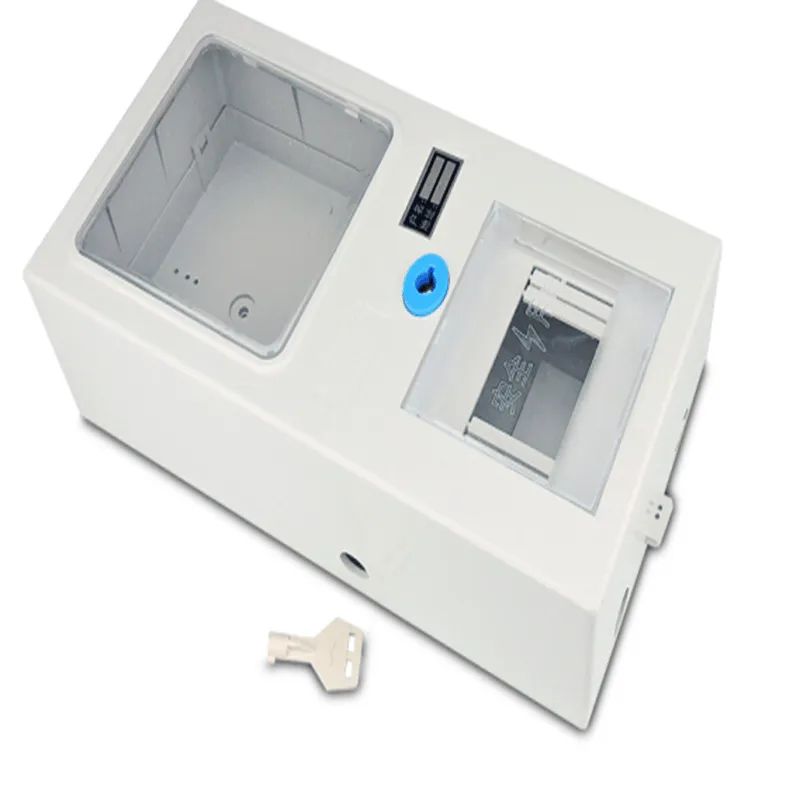
Advantages of SMC Meter Boxes: The Ideal Replacement for Metal Enclosures
Compared to traditional metal or ABS meter boxes, SMC meter boxes offer the following advantages:
| Performance Comparison | SMC Meter Box | Metal Meter Box | ABS Plastic Box |
|---|---|---|---|
| Insulation | Excellent, supports over 10kV | Poor, requires additional treatment | Moderate |
| Flame Resistance | Complies with UL94-V0 standard | High fire hazard | Flammable and deformable |
| Weather Resistance | Suitable for 30+ years of outdoor use | Easily corroded | Prone to aging and cracking |
| Strength and Rigidity | High-strength composite | Strong but heavy | Low |
| Weight | Lightweight and easy to install | Heavy | Relatively light |
SMC Meter Box Mold Manufacturing Process
- 1. Product Design: 3D modeling, draft angle analysis, CAE flow simulation
- 2. Mold Machining: CNC rough and fine processing, heat treatment, mirror polishing
- 3. Mold Assembly and Heating Circuit Design: Positioning systems, electric heating or thermal oil circulation layout
- 4. Mold Trial and Debugging: Check filling, demolding, surface quality, and cooling performance
Application Scenarios and Industry Prospects
As China’s "dual carbon" strategy drives the construction of green energy infrastructure, power systems are moving toward smarter, more efficient, and environmentally friendly development. As a key component of power equipment housing, SMC meter box molds are expanding their presence in the following fields:
- Residential distribution boxes and smart meter enclosures
- Distributed power systems in industrial parks
- Metering and control boxes in wind/solar power systems
- Enclosures for 5G communication base station equipment
- Control cabinets for EV charging stations
In the future, with the development of Carbon Fiber Reinforced SMC (C-SMC) and eco-friendly Low-Density SMC (L-SMC), SMC meter boxes will become lighter, stronger, and more durable. This will drive mold design to higher levels of integration and multifunctionality.
Conclusion: High-Performance SMC Molds Drive Industry Upgrades
SMC meter box molds serve as a vital bridge between advanced composite materials and intelligent manufacturing of electrical equipment. Their design quality directly affects product performance and production efficiency. Choosing a professional mold manufacturer with capabilities in mold flow analysis, thermal balance design, precision machining, and molding process support is essential for upgrading electrical products and enhancing production efficiency.

To learn more about SMC mold development, BMC molding, or automated production line solutions for SMC meter boxes, feel free to contact us for customized support.