Warpage is one of the most common quality challenges in Sheet Molding Compound (SMC) compression molding. Even when a component meets dimensional requirements immediately after demolding, it may gradually deform during cooling or subsequent assembly, affecting appearance, sealing performance, and dimensional accuracy.
For manufacturers producing automotive body panels, battery covers, electrical enclosures, sanitary ware, and other composite components, controlling warpage is essential for improving product consistency and reducing production costs. Because warpage is influenced by multiple factors—including material behavior, mold design, temperature distribution, curing conditions, and part geometry—effective solutions require a comprehensive engineering approach rather than a single process adjustment.
This article explains the primary causes of SMC warpage and provides practical recommendations for reducing deformation through optimized mold design and compression molding process control.
What Is Warpage in SMC Compression Molding?
Warpage refers to the permanent distortion of a molded component after it has been removed from the mold. Instead of maintaining its intended geometry, the part may bend, twist, bow, or exhibit uneven surfaces due to internal residual stress or uneven material shrinkage.
Unlike cosmetic defects such as surface scratches or pinholes, warpage directly affects product functionality. Even minor deformation can cause assembly problems, sealing failures, dimensional deviations, or increased rework during downstream manufacturing.
Typical forms of SMC warpage include:
- Overall panel bending
- Corner lifting
- Edge distortion
- Twisting of large flat components
- Local surface deformation around ribs or inserts
Why Do SMC Parts Warp?
Warpage does not result from a single defect. In most cases, it develops because internal stresses generated during molding are released after demolding. When different areas of a component shrink at different rates, the finished part naturally changes shape as these stresses redistribute.
Several engineering factors contribute to this phenomenon:
- Uneven mold temperature
- Non-uniform material flow
- Inconsistent curing throughout the cavity
- Improper fiber orientation
- Uneven wall thickness
- Residual stresses caused by rapid cooling
- Insufficient mold rigidity
- Poor part design
Because these factors often interact with one another, identifying the root cause requires evaluating the complete molding process rather than focusing on only one production parameter.
How Mold Design Influences Warpage
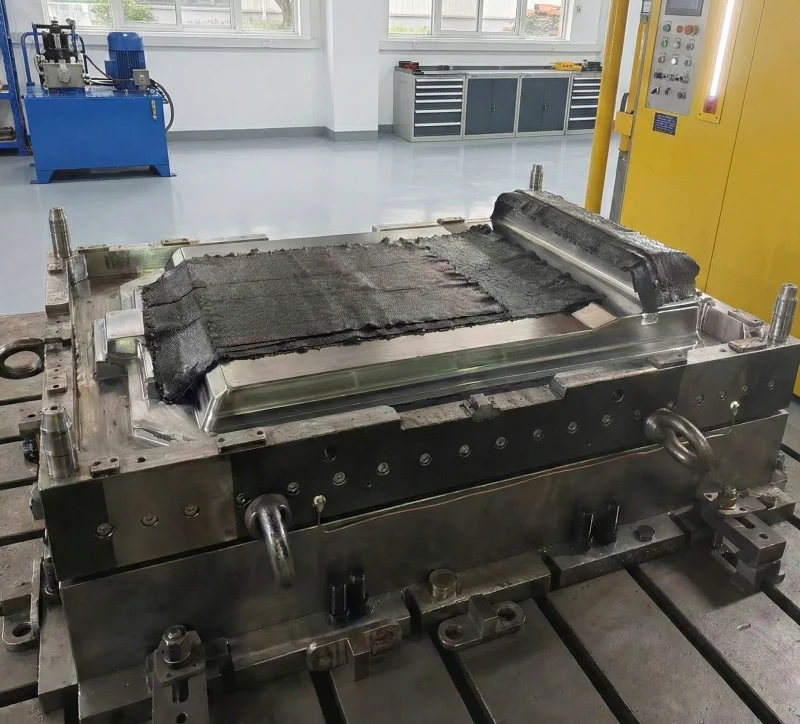
The compression mold plays a decisive role in determining whether an SMC component remains dimensionally stable after molding. A well-designed mold promotes balanced material flow, uniform curing, and consistent cooling, all of which help minimize internal stress.
Engineers typically consider the following design elements:
- Balanced cavity layout
- Uniform heating across the mold surface
- Optimized venting locations
- Proper draft angles
- Reasonable rib and reinforcement design
- Stable mold structure with sufficient rigidity
- Accurate parting line configuration
Modern mold flow simulation is also widely used to predict fiber movement, resin flow, pressure distribution, and potential deformation before the mold enters production. Early optimization during the design stage significantly reduces the risk of warpage in mass manufacturing.
Common Causes of Warpage and Practical Solutions
1. Uneven Mold Temperature
Temperature differences across the mold cavity cause different areas of the composite material to cure at different rates. Faster curing regions shrink earlier than cooler areas, creating residual stress that may lead to bending or twisting after demolding.
Recommended solutions:
- Design balanced heating channels.
- Use multi-zone temperature control.
- Regularly calibrate temperature sensors.
- Maintain stable mold temperatures throughout production.
2. Non-Uniform Material Distribution
Incorrect placement of the SMC charge can prevent material from flowing evenly throughout the cavity. Some areas become resin-rich while others contain insufficient reinforcement, resulting in uneven shrinkage and localized deformation.
Recommended solutions:
- Optimize charge pattern and placement.
- Verify material weight before each molding cycle.
- Use mold flow analysis during product development.
- Adjust charge size for complex geometries.
3. Improper Fiber Orientation
Fiber orientation strongly influences the mechanical behavior of composite materials. When reinforcing fibers align unevenly, shrinkage becomes directional rather than uniform, increasing the likelihood of warpage in large structural parts.
Recommended solutions:
- Improve cavity flow balance.
- Optimize rib layout and wall transitions.
- Reduce excessive flow distances.
- Validate fiber distribution through prototype trials.
4. Uneven Wall Thickness
Large differences in wall thickness can cause inconsistent curing and shrinkage throughout the molded component. Thick sections retain heat longer and continue curing after thinner areas have stabilized, generating internal stresses that eventually lead to warpage.
This issue is particularly common in automotive panels and electrical enclosures with multiple reinforcing ribs or localized structural features.
Recommended solutions:
- Maintain the most uniform wall thickness possible.
- Avoid abrupt transitions between thick and thin sections.
- Use gradual radii instead of sharp thickness changes.
- Optimize rib dimensions to improve stiffness without creating excessive material accumulation.
5. Insufficient or Uneven Curing
Incomplete curing reduces the mechanical stability of SMC parts. Components that are not fully cured may continue to shrink after demolding, resulting in delayed deformation during storage, transportation, or assembly.
Uneven curing often occurs when molding temperature, pressure, or curing time is not properly controlled across the entire cavity.
Recommended solutions:
- Establish stable molding temperature parameters.
- Optimize curing time according to material specifications.
- Verify temperature uniformity across the mold surface.
- Regularly inspect heating systems for consistent performance.
6. Rapid or Uneven Cooling
Cooling is often overlooked during process optimization, yet it has a significant influence on dimensional stability. If one area of the part cools much faster than another, uneven thermal contraction may generate internal stress that becomes visible as warpage after demolding.
Recommended solutions:
- Design balanced cooling channels where applicable.
- Avoid excessive temperature differences during cooling.
- Allow sufficient cooling time before demolding.
- Maintain stable production conditions throughout continuous manufacturing.
7. Insufficient Mold Rigidity
Large SMC molds are subjected to considerable compression forces during production. If the mold lacks sufficient rigidity, slight deformation of the cavity itself may occur under pressure, affecting part geometry and increasing dimensional variation.
This becomes increasingly important when manufacturing large automotive components such as roof panels, battery covers, or exterior body panels.
Recommended solutions:
- Use high-strength mold steel suitable for large composite tooling.
- Optimize support structures within the mold base.
- Perform structural analysis during mold design.
- Regularly inspect molds for wear and dimensional changes.
8. Improper Demolding Operations
Even when molding conditions are optimized, improper part removal can introduce additional stress into the component. Excessive force or uneven ejection may deform large composite parts before they have completely stabilized.
Recommended solutions:
- Ensure adequate draft angles during product design.
- Maintain smooth mold surfaces through regular polishing.
- Apply appropriate release agents when required.
- Follow standardized demolding procedures.

Best Practices for Reducing SMC Warpage
Successful warpage control is achieved by combining optimized mold design, stable process parameters, and consistent production management. Rather than adjusting only one variable, manufacturers should evaluate the complete molding system to identify the root causes of deformation.
Several best practices can significantly improve dimensional stability:
- Design molds with balanced heating and venting systems.
- Use consistent SMC charge weight and placement.
- Maintain stable molding pressure and curing temperature.
- Optimize product wall thickness and rib layout.
- Perform mold flow simulation during product development.
- Implement preventive maintenance for molds and heating systems.
- Verify dimensions through regular quality inspections.
Quality Inspection and Process Monitoring
Reducing warpage is not only a design challenge but also a quality management task. Continuous inspection during production helps detect process deviations before they affect large production batches.
Manufacturers commonly monitor the following factors:
- Mold temperature consistency.
- Compression pressure stability.
- Curing cycle repeatability.
- Finished part dimensions.
- Flatness and geometric tolerances.
- Surface quality and structural integrity.
Modern inspection equipment such as Coordinate Measuring Machines (CMM), laser scanners, and 3D optical measurement systems enables manufacturers to evaluate dimensional accuracy quickly and support continuous process improvement.
Why Choose SUASE for SMC Compression Molds
Reducing warpage begins with a well-designed compression mold. Even the highest-quality SMC materials cannot consistently produce dimensionally stable parts if the mold is poorly engineered or the molding process is not properly controlled.
At SUASE, we specialize in the design and manufacture of precision compression molds for SMC, BMC, and other fiber-reinforced composite materials. Our engineering team works closely with customers from the early design stage to optimize mold structure, material flow, temperature distribution, and manufacturing efficiency.
By combining advanced CAD/CAM engineering, high-precision CNC machining, and strict quality control procedures, we help customers reduce common molding defects such as warpage, voids, fiber exposure, and dimensional variation while improving overall production stability.
Our compression mold solutions are widely applied in:
- Automotive exterior and interior components
- New energy vehicle battery covers
- Electrical enclosures and insulation parts
- Sanitary ware products
- Building and infrastructure composites
- Industrial composite components
Frequently Asked Questions
1. What is the primary cause of SMC warpage?
Warpage is usually caused by uneven shrinkage and residual stress generated during compression molding. Factors such as mold temperature, curing conditions, material flow, fiber orientation, and product design all contribute to dimensional deformation.
2. Can mold design reduce SMC warpage?
Yes. A well-designed compression mold promotes balanced material flow, uniform heating, efficient venting, and consistent curing, all of which significantly reduce the risk of warpage.
3. Does wall thickness affect dimensional stability?
Absolutely. Large variations in wall thickness often lead to uneven curing and shrinkage. Maintaining a more uniform wall thickness helps improve dimensional accuracy and reduce internal stress.
4. Why is temperature control important in compression molding?
Stable mold temperature ensures consistent resin curing throughout the cavity. Uneven heating can create localized shrinkage differences that result in bending or twisting after demolding.
5. How can manufacturers minimize warpage during mass production?
Manufacturers should optimize mold design, control molding parameters, maintain consistent material placement, inspect tooling regularly, and monitor production quality using dimensional inspection equipment.
6. Does SUASE provide customized SMC compression molds?
Yes. SUASE provides customized compression mold solutions for automotive, electrical, sanitary ware, infrastructure, and other composite applications. Each mold is engineered according to the customer's product design, production capacity, and material requirements.
Conclusion
Warpage is one of the most challenging quality issues in SMC compression molding because it is influenced by multiple engineering factors rather than a single production parameter. Successful warpage control requires a combination of optimized product design, precision mold manufacturing, stable process control, and continuous quality monitoring.
From balanced cavity design and uniform heating to proper curing cycles and optimized material placement, every stage of the compression molding process contributes to the dimensional stability of the finished component. Addressing these factors early in product and mold development not only improves product quality but also reduces scrap rates, minimizes rework, and enhances overall manufacturing efficiency.
With extensive experience in composite compression mold engineering, SUASE is committed to helping customers overcome complex molding challenges through innovative tooling solutions and reliable technical support. By delivering precision-engineered molds and continuously improving manufacturing processes, we enable customers worldwide to produce high-performance SMC components with greater consistency and confidence.